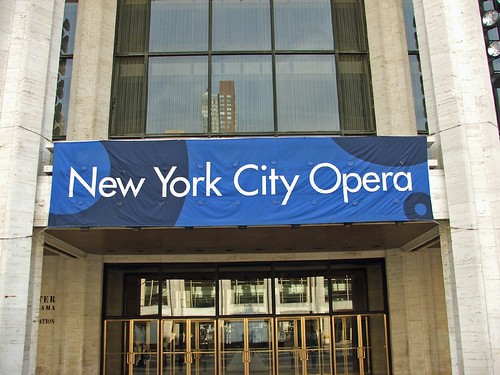
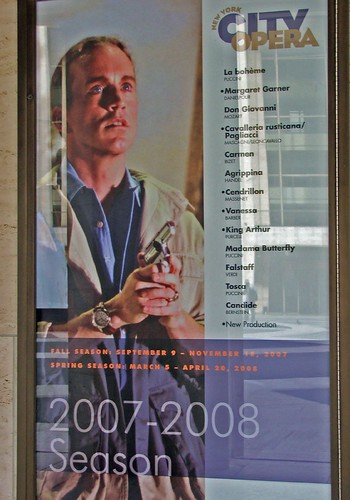
I was disappointed with Vanessa by Samuel Barber, which began its season at the New York City Opera on November 5. The production and singing were fine; but I don’t think Vanessa really works as an opera. My immediate thoughts about why this is so relate to the story of the work which is simple enough to tell.
It is set in “a northern country”.
Vanessa has waited 20 years in her house for the return of her lover Anatol.
It is a grand house with many servants.
She lives with her mother, the Baroness, (who refuses to speak to her) and a younger woman, Erika, described as her niece.
Anatol does not return, but his son, also named Anatol, arrives and advises his father is dead.
Anatol seduces Erika who refuses his offer of marriage twice. Erika is pregnant.
Vanessa falls in love with Anatol.
Vanessa and Anatol’s engagement is announced at a party: Erika first faints then runs out towards the lake.
Erika is brought back alive but loses her child.
Vanessa and Anatol depart for Paris; leaving Erika at home with the Baroness who now refuses to speak to her. “It is now her turn to wait”.
Many of the events are mediated by The Doctor, and amiable but self confessedly inept medical man, who may have wandered in from Chekhov.
I think that the problem with the opera is that the story does not make sense as a realistic one. And it doesn’t seem to be an allegory or the retelling of a myth. People, outside of psychiatrists’ case books just don’t behave like this. So there is no believable emotional structure to which the music can attach.
Some accounts of the opera mention without elaboration that there are hints of incest in the story. Thanks to a gentleman in sitting behind me in the theatre who told the world at large about this secretive sub plot I can reveal it here.
Before the arrival of Anatol II Erika asks if she should read to Vanessa. Guess what she reads:
Oedipus: Woe, woe is me,
Sorrowful that I am!
Where am I, where am I going?
Where am I cast away?
Vanessa is dissatisfied with Erika’s reading of this and has her own turn. It is so apposite to Vanessa’s own unfortunate condition. As for Oedipus: did Anatol II kill Anatol I so as to marry his mother?? And while we are at it, is Erika really Vanessa’s niece, or maybe……
All of this may be significant for Freudians; and it could be that the members of the audience at the Met who greeted the first performance in 1958 with a standing ovation were all in analysis themselves.
To me, it just adds to the confusion. When Erika goes missing and is found, Vanessa seems to have a maternal concern for her; but if that’s what it is, it is completely gone by the end. A hard but pleasure seeking Vanessa shows no concern at all for Erika’s plight.
Apparently, Barber was inspired Isak Dinesen's Seven Gothic Tales, and suggested his librettist Gian Carlo Menotti make use of them. The libretto does not adopt any of the stories but draws on
The Gothic for inspiration.
Isak Dinesen was the pen name of Danish author Karen Blixen.
A website devoted to her and her work
http://www.karenblixen.com/question101.htmlrelates:
“Karen Blixen was escorted to the opera on January 7, 1959, by the composer himself and Menotti. However, part way through the performance she pleaded illness and left the theater. Her secretary says, in Notater om Karen Blixen, that Barber was "upset" by her premature departure from the opera. Karen Blixen made no public comment.”
The music which is tuneful but not particularly engaging has many and varied references to other composers and other operas. There are two duets for Vanessa and Anatol II which give plenty of scope to the singers, and which were well sung in this production, but there is a lack of connection. I was not made to care what these cardboard cutouts thought or felt. An essential element of opera went missing.
As I mentioned, the realistic set, the singing and the orchestral playing were good. Richard Stilwell as The Doctor almost stole the show. It was remarkable that The Baroness was sung by Rosalind Elias, who created the role of Erika almost 50 years ago. She had noticeably smaller voice than the others, but was otherwise fine in a role which would have been more taxing had the Baroness been more talkative.
And now for something completely different. Writing in the New York Times, Anthony Tommasini said:
At City Opera, thanks to a simple but effective production by the director Michael Kahn; an excellent cast headed by the soprano Lauren Flanigan, who gives a smoldering portrayal of the title role; and crucially, the urgent and sensitive conducting of Anne Manson, in her company debut, “Vanessa” emerges as an authentic American masterpiece.
I am not persuaded. I wonder if, because of Barber's pivotal role in the development of American music, critics like Mr. Tommasini, want to believe he was a better composer than he actually was. In his recent book The Rest is Noise, Alex Ross says:
Whenever the American dream suffers a catastrophic setback, Barber’s Adagio for Strings plays on the radio.
I shouldn’t be messing with the American Dream.
Vanessa – New York State Theatre at Lincoln Center – Sunday 5 November 2007



 Posts
Posts


(Revised 6 September 2009)
I visited Brisbane for a commercial purpose but went down to the Queensland Art Gallery as well, mainly to see the exhibition Mountains and Streams, since I am taking an interest in Chinese Art at the moment by attending the lectures Literature and Legend at the Sydney gallery. The lectures on Chinese Art are part of series which moves on to Japanese Art later. I thought the Chinese lectures would be a useful prelude to the Japanese ones but despite their variable quality I found much interested in the history, art, and literature discussed. I found I had seen Mountains and Streams previously at the NGV in Melbourne where it originated but had almost no memory of it, attributable, I think, to my complete ignorance of Chinese art when I first saw it. So I saw it again with a little more insight.
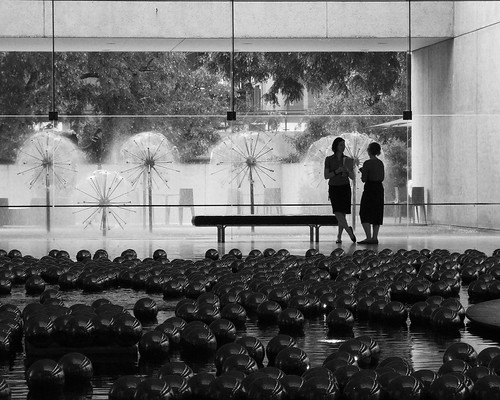
But the highlight of my visit to the Queensland gallery was my discovery of Yayoi Kusama, a Japanese artist whose installation, Narcissus Garden, is a striking feature of the gallery itself. The Queensland gallery is new. I found it to be a splendid large and open space very well designed for the display of painting and sculpture.
The installation by Yayoi Kusama is a version of a work which she first showed in 1966 at the Venice Biennale; or rather outside it, since she had not been invited. It was a very effective action and brought attention not only to herself but also to the way in which official displays of modern and inventive art soon become as ossified and bureaucratic as anything else. At the Biennale Kusama first offered the individual mirror balls for sale at $2. When she was somehow prohibited from doing this she gave out leaflets praising her own work.
Other versions of this work have appeared in the Serpentine in London and the small boat lake in Central Park, NYC. From photographs, it seems that the mirror balls were set out on the grass when they first appeared at Venice but subsequently floating in water. The essence of the installation is the reflective balls themselves. It looks from photographs as if their surroundings at Brisbane have changed a little from time to time; and in other places they seem to be out of reach and more clumped together in the waters and lakes in which they are floating.
In Brisbane the accumulation of balls looks simple and elegant and attracts attention by the constant movement helped along by the notices calling for them to be touched gently.
I find that Kusama has been an influential artist for 50 years. She was born in Matsumoto in 1929 and traveled from Japan to the USA in 1958. She was soon in New York where she was active in painting, sculpture and the organization of happenings for some years. She was therefore involved in making installations and other similar works when the concept was truly innovative and she was able to work with originality and flair. It may still be possible to do this, but the passage of time has made so many of such things seem mundane and derivative.
Although not apparent in Narcissus Garden, Kusama has described her work as emerging from her mental illness: she says has had hallucinations since she was a child. She also says that her ability to produce artistic works is a therapy for her.
Kusama often appears in photographs of her work. In a picture of the installation at Venice she is seen lying on the ground amongst the metallic balls in a red jumpsuit. In more recent photographs she poses staring intently at the camera. I wonder about the border between mental illness and self promotion.
Or could it be a characteristic of Japanese artists who move to the west. I am reminded of the self portraits of Fujita staring languidly from the picture; and of his self promotional antics in Paris in the 1920s.
And I can now add Masami Teraoka whom I discovered in Melbourne even more recently. His MacDonald's Hamburgers Invading Japan / self portrait shows the same trait:
http://en.wikipedia.org/wiki/Image:Teraokaselfportrait.jpg
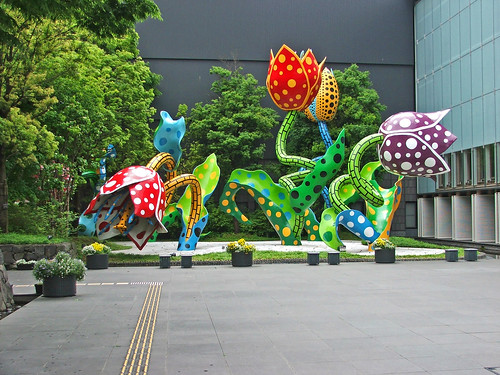
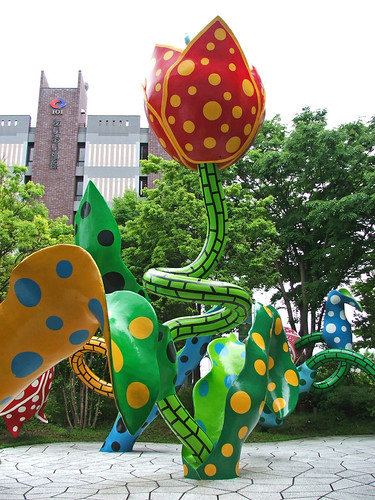
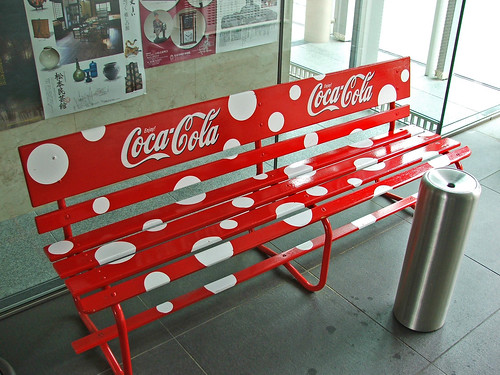
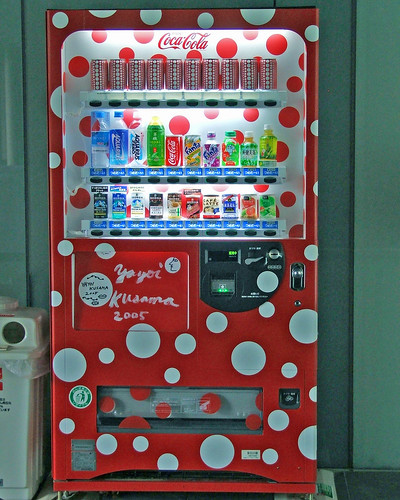
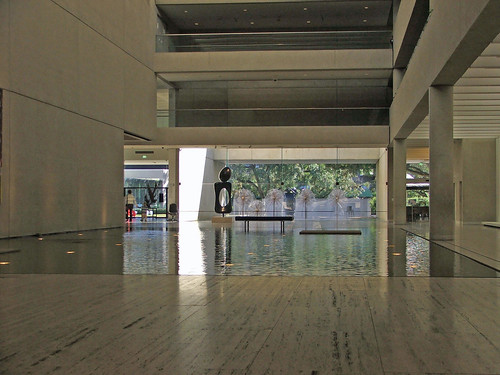
And so it was that in late May 2008, I made my way to Matsumoto, taking the super wide Shinano via Tsumago/Nagiso. I enjoyed my brief visit to Matsumoto. I missed a special retrospective exhibition of Kusama's work by only a week or so. However, as Matsumoto is her home town, the Matsumoto City Museum of Art maintains a permanent exhibition of her work. In fact, her Visionary Flowers (2002) dominates the front of the building; I imagine it was made for the site as the museum opened in that year.