Friday, 5 December 2008

Ethical Culture

Ethics

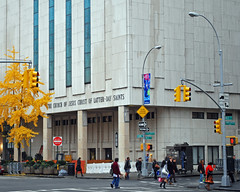
J. Robert Oppenheimer the subject of John Adams’s Doctor Atomic, which I saw at the Met earlier in November, attended school at the Society for Ethical Culture, so it was appropriate that the Chamber Music Society of Lincoln Center was performing there during the renovations of Alice Tully Hall. I heard one of a program of four concerts given under the title “Night Fantasies”. It was lucky I didn’t chose the first concert on November 20 as this was cancelled following a small fire in the basement. I walked past that night and saw the fire trucks and concert goers milling about, but didn’t learn the concert had been cancelled and rescheduled until an announcement at the beginning of the concert on November 21. They had to extend the hire of some percussion which was on the stage on Friday but not used.

The seating in the hall is in two levels in a semi circular formation around a low stage.
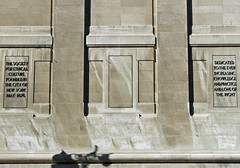
Above the stage is an inscription:

"The Place Where People Meet to Seek the Highest is Holy Ground"

The acoustics were good as well. The program ingeniously included three fairly short works with a numerous short movements. The principal artists were the Pacifica String Quartet, which I was interested to hear as I recently purchased their CD of two of the string quartets of Eliot Carter, which I plan to use, if time permits, to see if listening to Carter as a stream of consciousness, (an idea discussed by David Robertson in his recent Stuart Challenger lecture) helps at all with this difficult music.

The performance I heard on 21 November demonstrated the quartet’s great commitment to and understanding of contemporary music.

The program opened with a performance of Gyorgy Ligeti’s String Quartet No. 1 “Metamorphoses nocturnes”. My interest in Ligeti’s music was enlivened this year by a performance of his horn trio at the AFCM Townsville, but a CD I bought of this trio disappointed.

The String Quartet No.1 is about 20 minutes long and divided into 12 movements which are very short accordingly. They are fragments really. Each is different; and some of them had the same intense rhythmic drive I admired in the horn trio.

Next was another work of 20 minutes duration: Black Angels (Thirteen Images from the Dark Land) for Electric String Quartet by George Crumb.

My only previous encounter with Crumb’s music was a performance of Vox Balaenae (Voice of the Whale) (1971), for electric flute, electric cello, and amplified piano at the AFCM a couple of years ago. The musicians wore masks for that (I don’t know if the masks are required by the score). It was notable for the excellent whale song imitations of the amplified cello which were quite moving (suggesting that Alan Hovhaness went to unnecessary trouble in incorporating recordings of real whale song in And God Created Great Whales).

If I count correctly there are 13 movements in this work. I have seen the Kronos Quartet play with electronics attached to their instruments but in this concert the amplification seemed to be done by individual microphones on stands. There was more to it than amplification however. The members of the quartet also played tuned drinking glasses set up on stands behind them, struck gongs and sang or vocalised. There was also an intriguing passage in which the players bowed the neck of their instruments, yielding an early music viol effect.

13 movements in 20 minutes with such a variety of effects was certainly interesting if hectic, and I haven’t mentioned the references to “Death and the Maiden” and other works which I was unable to hear. I would describe the piece as interesting and fun but the composer had much deeper thoughts. “The numerous quasi – programmatic allusions in the work are therefore symbolic, although the essential polarity – God versus Devil – implies more than a purely metaphysical reality” is just part of a long note by the composer. Fortunately the music is not as ponderous.

After intermission the quartet was joined by soprano Claron Mc Fadden in a performance of Lyric Suite for String Quartet with Soprano by Alban Berg, which was also full of interest but which I will need to hear again before being able to comment.

The programmer recognised that there can be too much of a good thing, I think, and abandoned stark modernism to conclude the concert with the charming Chanson perpetuelle for Soprano and Piano ( Gilbert Kalish) Quartet by Ernest Chausson.

Tuesday, 2 December 2008

Bach Penderecki Beethoven

pgm

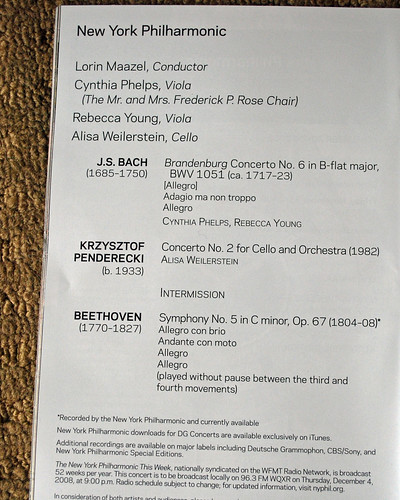
I haven’t heard much of the music of Krzysztof Penderecki. In 1973 I was greatly impressed by his opera The Devils of Loudun at the ENO in which Geoffrey Chard gave a memorable performance as Urbain Grandier. But that is a long time ago now. So to the New York Phiharmonic which performed his Concerto No. 2 for cello and orchestra directed by Lorin Maazel with Alisa Weilerstein as soloist.
The concerto begins with a long orchestral introduction which is loud and of ominous intent. It would be disrespectful to suggest that the work should be named 50 ways to feel really anxious. The strings make sounds like air raid sirens; there are bursts of staccato playing from trumpets and eerie bells and gongs.
The cello part which weaves in and out of this background was marvelously played by Ms. Weilerstein. It left me with the impression that it was a fascinating cello sonata trying to escape from the orchestra.

It would not be unfair to say that the program for this concert was strange. Prior to the Cello Concerto we heard Bach’s Brandenburg Concerto No. 6, performed by two violas, two violas de gamba, cello, bass and harpsichord: the ensemble for which it was written. The unusual feature of the performance was that Mr. Maazel appeared to conduct it. I wasn’t the only person to think this was odd - the Times music critic mentioned it. I have enjoyed the performances of Brandenburg concertos which have ended Bach night at the AFCM Townsville in which ensembles of similar size have played the works with a vigour which makes the pieces sound as if improvised. There was no chance of that here under the conductor’s steady beat; but there was a lovely sound from the unusual combination of low strings.

After intermission there was an excellent performance of Beethoven’s Fifth Symphony. The people next to me said they had heard it before and left at intermission. I may lack their sophistication but I stayed to the end.

New York Philharmonic, Avery Fisher Hall, 20 November 2008.

Tuesday, 25 November 2008

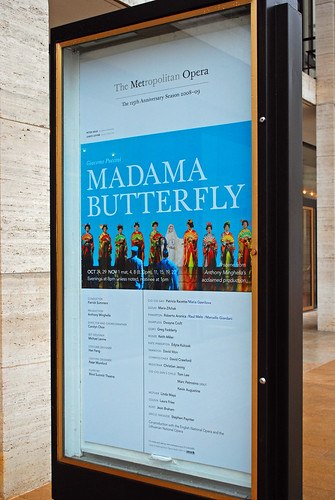
MADAM BUTTERFLY

MB


I am now familiar with the Met’s production of Madam Butterfly having seen it in the two previous seasons and I wrote about it here last year. The performance was overshadowed by the death of its director, Anthony Minghella, in March this year. Like Baz Luhrmann, he was able to create an opera production which was both undeniably modern and true to the spirit of the work at the same time.
This Madam Butterfly is well paced, visually exciting and was again beautifully sung. The first time I saw it I was entranced by the Chilean soprano Christina Gallarda-Domas in the title role, and she returns in 2009, but on this occasion Patricia Racette was a fine Butterfly. Pinkerton was Italian tenor Marcello Giordani, in for Robert Aronica, who was ill. Mr. Giordani is here to sing Faust in The Damnation of Faust. He not only added Pinkerton but also sang both roles in the one day on Saturday when I saw his Faust at the matinee. The New York Times which, in happy contrast to papers I can think of, provides an interesting coverage of what goes on here, reported this and added:

In a statement, Peter Gelb, the Met’s general manager, said, “Marcello Giordani is a wonderful artist but also the iron man of tenors.”

The Act 1 duet was excellent, but I would have liked more real remorse from him at the end; but iron men probably don’t cry.

Sharpless, the consul was Dwayne Croft. I think there is more in the character than he was able to find. Suzuki was sung, as last year, and the year before by Maria Zifchak. It comes as no surprise that she is asked to return as she is perfect in the role.

Patrick Summers, a regular visitor to Opera Australia, conducted the Met orchestra. It was a very lyrical performance, downplaying the melodrama, but complementing the design and flow of the production perfectly.

The 826th Metropolitan Opera Performance of Madama Butterfly, Wednesday 19 November 2008 at 8pm.

Sunday, 23 November 2008

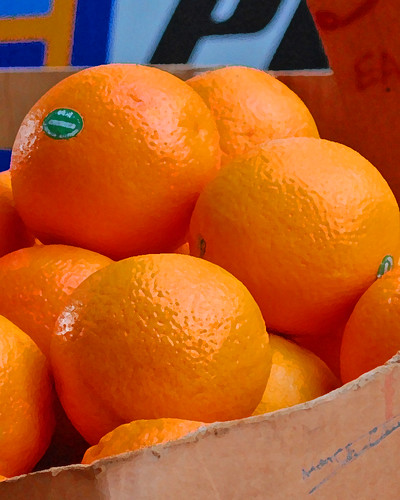
Love for Three Oranges

Three Oranges


I’m sure if you stay in New York long enough everything in the world will come to you. Last week the Kirov Orchestra of the Mariinsky Theatre St. Petersburg was here playing a series of concerts devoted to the works of Prokofiev, and on Sunday I saw their concert performance of The Love for Three Oranges, a favorite of mine, which I saw a number of times in Opera Australia’s recent production of the English translation by Tom Stoppard.

I was excited to find that my seat purchased over the internet months ago in row D was in the front row. And more so when I discovered that the row of chairs set up in front of the orchestra would not be used by the singers sitting in a row. Although a concert performance with no scenery or props – apart from a clip on bow tie which became the beautiful ribbon which entrances the ferocious cook who keeps the three oranges in her kitchen – the singers performed without music and acted their parts using the whole width of the stage. Having an uninterrupted and close view I could see that all of them were completely absorbed in their performances, and they all sang marvelously as well. The orchestra was conducted by its director the amazingly disheveled Valery Gergiev who occasionally stepped back from his music stand to direct groups of the singers from their midst.

I don’t think I have ever seen a program or artist’s biography which reveals the age of a singer, but it was clear from appearances and the years in which all the members of this cast had graduated or won prizes that they were all young and would be surprised if any of them was older than say 35.

Alexei Tanovitski caused a little confusion at the outset as he sang both the King of Clubs and the Herald, but the Herald was soon gone and it was clear who he was. Though he is young his bass was reminiscent of the deep Russian bass singers familiar from Orthodox liturgical music. Bass baritones are usually solidly built, so Pavel Shimanovich who sang Celio came as a surprise. His voice did not have the liturgical growl of the King of Spades, but he was a fine bass baritone though short and slight.

There are too many characters in Love for Three Oranges for me to list them all: they all sang well. Though the Tom Stoppard translation used by OA was very witty in itself and a highlight of that production, there is nothing like hearing it sung in Russian by Russians. The unique sounds of the language belong with the music and the whole effect, together with the excellent orchestra and chorus was overwhelming.

Love for Three Oranges is both a fairy tale and an ironic commentary on theatrical traditions. It shows that you can have great Opera about nothing of importance, at least which can be described in words. As a composition, it is perfect. There is not a note too many, and the music is a perfect compliment to the story and the text, especially with the sound of Russian voices.

Prokofiev, Love for Three Oranges, Kirov Orchestra and Chorus of the Mariinsky Theatre, Avery Fisher Hall, Lincoln Center, Sunday 16 November 2008, 3pm.

La Traviata

Verdi


Last year I wrote here about the Franco Zeffirelli production of La Traviata at the Met, and I saw it again, with a different cast, this year. There are so many variables in any performance, including the mood and state of mind of the listener (me) that it’s not easy to judge after an interval of a year why I found the production so much more engaging this time. Last year I seemed irritated by the ballroom scene, Act II scene 2, in a way which surprised me when I re read my comments. This time the whole production seemed to flow seamlessly maybe on account of the lack of surprise in some of the scenic effects.

Violetta was sung by German soprano Anja Harteros, who was very strong and whose performance I enjoyed more that that of Renee Fleming last year. Alfredo Germont was Massimo Giordano, from Italy, who looked youthful and sang well. Last year I wrote about my reevaluation of Giorgo Germont who for many years I wrongly characterized as the most boring person in all of opera. In fact, his dialogue with Violetta in Act II Scene 1 can be fascinating, and the performance of Zeljko Lucic (seen last year as Macbeth at the Met) confirmed this. He began with an outburst, but soon abandoned bluster as he moved through the scene with Violetta. It was a subtle and thoughtful performance. I think it should remain an open question whether his impression of Violetta really affects him emotionally or whether he is a crafty old man determined to get what he wants come what may. If the latter, it adds an interesting twist to his remorse at the end of the opera: a realization that he has been too clever for everyone’s good.

The 951 st production of Verdi's La Traviata at the Metropolitan Opera Saturday 15 November 2008 at 1 pm.

Wednesday, 19 November 2008

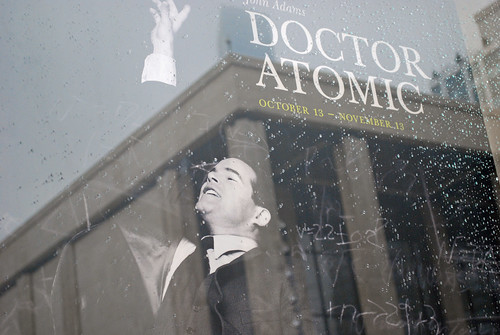
JOHN ADAMS IS BEHIND THAT HEDGE

atomic2

I had dinner with some Met supporters and staff before seeing the last performance for the season of John Adams’s Doctor Atomic. Our tables were separated from the restaurant proper by some bushes in tubs. The Met person told us “John Adams is behind that hedge!” You can’t get any closer to a contemporary opera than that.

There should be a strict rule against recording conversations overheard in theatres and buses and I will follow that rule forever more. But what I overheard prior to Doctor Atomic was very odd and was related to the opera as well.

The main curtain used for Doctor Atomic has a large reproduction of the classic periodic table of elements printed on it. A young couple was seated immediately behind me.

Him: “That’s really interesting: it’s the periodic table….hey … there’s palladium…it’s a very interesting metal.
Her: “What about mercury?”
Him: “I’m not a big fan of mercury.”

“Do you see gold – it’s so malleable and such a great conductor of electricity.”

“I see Chlorine, and Fluorine there - I’m not a big fan of those pharmaceutical elements……”


I am a big fan of Doctor Atomic. I was going to write a lot about it, and may still do so, as it has attracted quite a bit of negative criticism much of it wrongheaded.

I was lucky enough to see the first production of the opera in San Francisco in 2005, and was impressed by it then. Many works need more than one hearing before you can assimilate and begin to understand them. However, I left Doctor Atomic in 2005 with a strong overall impression of the work and distinct memories of two arias: Kitty Oppenheimer’s “Am I in Your Light” and the setting of the Donne sonnet “Batter my Heart” for Oppenheimer himself which ends the first act.

The libretto by Peter Sellars has been criticized as an unwieldy kind of amalgam of miscellaneous poetry and contemporary accounts of the bomb test. I think this overlooks the fact that J. Robert Oppenheimer was himself an exuberant polymath who saw himself in terms of the literature he read. Oppenheimer was recorded as quoting the Donne sonnet for example, and it had some particular biographical associations for him. The references to the Trinity and their relation to the naming of the test site are obvious.

Since its first performance in San Francisco the opera has been seen, in versions of the original production in a number of places, and John Adams has revised it as it has moved from one place to the next, but it’s still very much the same piece. It’s a great tribute to the work that the principal singers who appeared in San Francisco are still in it. Gerald Finley has made the role of Dr. Oppenheimer his own and I agree with Met director Peter Gelb that his is one of the great virtuoso performances of the 21st. century. Eric Owens (General Groves ) and Richard Paul Fink ( Edward Teller ) remain in their original roles.

Peter Sellars was producer in San Francisco and beyond but the Met has commissioned a new production from Penny Woolcock, which is not that different from the original. The last act is still dominated by a hovering reproduction of “the gadget” as the bomb built for testing was known. This production uses what seems to be the new operatic cliché: singers in stacked boxes – but notwithstanding this, I think it achieves greater coherence and intensity. As the opera itself has been changed, it wasn’t clear to me how much of the improvement was to the work itself and how much to the production. For example, a much criticized part of the original was the music, dance and mime performed by Kitty Oppenheimer’s maid Pasqualita and other Native Americans. Pretty clearly, this was intended to contrast the relationship between the New Mexico desert and its longtime inhabitants with the terrible explosion to take place at Los Alamos. This was not incongruous and did not involve wallowing in political correctness either. In the original production however this aspect did seem detached from the main thread and included some less than inspiring dance. Now it is a lot more coherent. Pasqualita was beautifully sung by Meredith Arwady, whom I would describe as a contralto and a deep voice at that; I must investigate why the Met doesn’t recognize “contralto”, it only hears “mezzo sopranos”.

Not everything was better, Kitty Oppenheimer’s movements around the bed during “Am I in Your Light”, caused the action to lose touch with the text.

The Met Orchestra was conducted by Alan Gilbert who will take over the New York Philharmonic next season. There can be no better opera orchestra anywhere, and while the San Francisco orchestra was fine, the playing here was extraordinarily good. Apart from the arias and set pieces, the orchestral score is alive with movement, urgency and anticipation and all of this was perfectly realized.

The Act I finale, the setting of “Batter my heart”, was an intensely moving experience. .Gerald Finley is probably more restrained in his movements than when I first saw him sing it, but this was an amazing and even more powerful performance. John Adams’s setting of the poem has been criticized as insufficiently true to the verse, particularly because of the repetition of some lines. First, this is an opera not a song cycle and the original poem cannot be damaged by the way it is used here. Secondly, any critic should hear Britten’s setting of the poem in his “Holy Sonnets of John Donne” which to me sounds frenetic and superficial by comparison. I think the music here would stand in any context.

The score also includes some electronic music and some poignant spoken Japanese text at the end. This means that there is some amplification. I think the singing or some of it is amplified, but I did not find this troubling. I just don’t like amplified sound in opera. Particularly towards the end there was a repeated motif on a tuba or euphonium, a foreboding of doom I suspect, which was just too loud. Perhaps one day there will be a minimalist version of Atomic without electronics or amplification.

Sunday, 16 November 2008

Some Russians

NYP

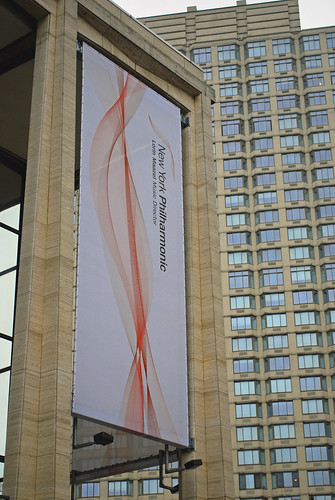
Just like in the movies the traffic on Broadway was at a standstill with horns blasting as I headed out the New York Philharmonic on Wednesday. I then saw the hold up was caused by a demonstration several thousand strong proceeding south on the other side of the street. At first, it was hard to work out what it was about. I saw various banners and signs

LOVE NOT H8

SEPERATE IS NOT EQUAL

I LOVE MY MORMON FAMILY

JESUS LOVES ME AND MY BOYFRIEND

As I walked along, it became clear the procession was a protest about the adoption of Proposition 8 in the referendum which California held on November 4. Others were as mystified as I was about why the demonstration was happening on the upper west side of New York City.

“Proposition 8 is California isn’t it – why are they here?”
“Sympathy I guess”
“Do you think so?”

And one older lady clambering into Avery Fisher Hall, clearly not into IM:

“I don’t get this aitch eight”

Unexpectedly, the clue to the thing was the Mormon sign. There is a large Mormon church opposite Avery Fisher Hall, and it has now become apparent that the Mormons poured millions of dollars into support of Proposition 8. An article in the New York Times today suggests it would not have passed without this support.
Mormon


The concert was the New York Philharmonic conducted by Andrey Boreyko with Gil Shaham playing the Khachaturian violin concerto.

The concert began with a short tone poem, Kikimora, by the Russian composer Anatoly Lyadov (1855 – 1914). Hello Mr. Melody Man!: the only work of Lyadov I could think of was his A musical snuffbox used as a theme by Lindley Evans on the ABC Childrens Hour so long ago. Kikmora was a pleasant if not very memorable piece which brought Rimsky – Korsakov’s music to mind. (And Lyadov was Rimsky Korsakov’s pupil.) It was interesting to hear it in this program which ended with the 1919 version of Stravisnky’s Firebird Suite, as I realised listening to Kikmora that works like Firebird and Petrushka which struck me as unique inventions when I first heard them had very strong roots in works of this kind. In fact, the program note explains that Diaghilev was a pupil of Lyadov, and wanted him to compose the Firebird score and only turned to Stravinsky when Lyadov failed to “fish or cut bait”. Though I doubt Diaghilev put it that way.

I learn from the Wikipeida that Liadov’s pupils included Prokofiev and Nicolai Malko, another link with the distant past as Dr. Malko was chief conductor of the SSO, and I remember sitting in the organ gallery of the Sydney Town Hall watching him, deathly pale, conducting the orchestra. His appearance was not deceptive as he lived for only a short time after that concert.


Next came the violin concerto. I saw Gil Shaham play here a couple of years ago but was unprepared for this exuberant performance. He smiled broadly at the conductor and then at no one in particular. He crouched, he move around the platform between the conductor and the first violins, often approaching the conductor so closely that he appeared to be playing for him rather than the audience. From where I was seated at the left front he entirely disappeared behind the conductor at times. In the slow movement his facial expression changed to one of ecstatic reverie, .but the gawky broad smile was back for the finale.

None of this was inappropriate for the concerto, a lively work with great melodies which becomes very exciting at times, especially when the violinist is a crouching tiger.

After intermission the orchestra played Abii ne viderem for String Orchestra, Alto Flute, Piano Harpsichord and Bass Guitar by the contemporary composer Giya Kancheli who was born in Georgia but now lives in Belgium. I did not know of Kancheli, and for me this was the most interesting work in the concert. The list of solo instruments gives a false impression as the flute is the only on with a significant solo part, and that consists at times of the repetition of a single note. The program says that Kancheli is numbered amongst Eastern European composers who have explored the “new mysticism”. I remain skeptical about program music mystical or otherwise, but the piece contain a range of sounds which demonstrated that a traditional orchestra still has a great deal of life left in it. Many fascinating sounds and contrasts and a lot of silence ( maybe the mystical part ).

The concert ended with a fine performance of the 1919 version of Stravinsky’s Firebird Suite. This version was scored for a smaller string section than the ballet itself and the Philharmonic followed the score. I have found that the acoustics of Avery Fisher Hall vary from place to place, but where I was sitting the grinding deep bass from the basses which opens the work was marvelous to hear. The woodwind parts were also crystal clear and subjectively at least somewhat louder than they usually seem. This was odd, because the Philharmonic is arranged on a flat platform and from where I was in front of any raking in the seats I was unable to see the woodwind section at all.