Saturday, 12 March 2011

Nixon in China


According to Google Earth, my house is 15,968.78 kilometres from the Metropolitan Opera New York, so it isn't practical to go there as often as I would like.   I would have liked to have seen the recent production of Nixon in China, a marvellous work and a turning point in the development of modern opera.  At least these days we have internet streaming and the live HD broadcast's to cinemas, although here they are not live, probably because few of us, no matter how good our intentions, would be there at 5 am of a Sunday morning.   So we saw a recording two weeks after the Saturday matinee which was telecast.  Good as these transmissions are, it is quite a different experience from being there.

Nixon in China has music by John Adams to a libretto by Alice Goodman. It was originally devised and produced by Peter Sellars, who directed the Met production. John Adams conducted in his Met debut.


The music is remarkable and memorable. There may be exceptions, but I think there should be music in opera which engages us as we listen; and which we can remember later on. I was pleased to see this thought echoed in Michael Tanner's article in The Spectator about the recent premier of Mark-Anthony Turnage’s new opera, Anna Nicole. He said that ...one of the cardinal musical weaknesses of the piece (is) that it sends one out of the theatre with nothing musical going on in one’s head. When I first saw John Adams' Doctor Atomic in 2005, I had the impression it was a work that would last for this very reason. The powerful aria Batter my Heart, and Am I in Your Light, were not only engaging at the time but, remarkably for a piece newly heard, remained with me long after.


In Nixon we have the thrilling soprano aria I am the Wife of Mao Tse-tung, a little of the music more developed in Adams' orchestra piece The Chairman Dances and the pastiche which satirises the revolutionary vogue for group composition accompanying the revolutionary ballet.


We also have the RN's long aria News ... has a kind of mystery, which is an example of the sympathetic way in which the libretto and the music treat him. The other example is his monologue in the third act about his experiences in the second world war. Nixon's character is carefully developed to avoid the stereotype Watergate villain. Speaking at an event webcast on WQXR/Q2, John Adams said that at the time the opera was written all most people saw of Nixon was a succession of comic mimics on late night television.


On the same webcast, Peter Sellars saw the writing of an opera about recent historical events in a various ways. He said that the usual television commentary made a snap judgement and then moved on; it presented historical events inconsequentially so that we don't have the same feeling about the significance of historical events as we have about the history of past centuries. Music and poetry can lift you past the facts into a visionary space which offers us something much more profound.


He also saw Nixon as an instance of what opera can do: we go to a place that was never announced at the beginning . He saw this as a place for secret thoughts, a place you don't have words for, which creates feelings which none of us know how to process.


I think this gives us a good idea where we are headed in Nixon. The opera begins in a documentary way, depicting the arrival of the Nixons in Beijing and the his meeting with Mao. It then veers off into a surreal landscape inspired by a performance of the revolutionary ballet The Red Detachment of Women, in which Henry Kissinger somehow becomes a sadistic landlord and Pat Nixon intervenes in the action to save his victim. The last act consists of monologues by Nixon, Chou En Lai and Mao in which they provide a historical context which, up to that point, was missing, and an imagining of what was going on inside their heads.
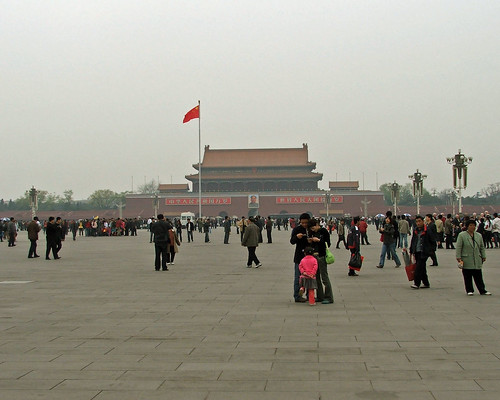
Tiananmen Square


Of course we have no idea what was going on inside their heads. History books which invent dialog are often and rightly condemned. Opera is not a history book; and one of the things it can do is create a world which simulates the kind of thoughts we have when thinking about past events. I don't think when we read history we always convert the story into a catalogue of established facts; we do the opposite. We imagine what it would have been like to be a Nixon or a revolutionary in China, and the opera give a voice to such thoughts and feelings, just as opera gives a voice to the thoughts and feelings of a Tosca or a Violetta.


Max Frankel, a journalist who covered Nixon’s trip to China, does not accept this. In an article in the New York Times, he argues that operas shouldn't be based on contemporary events. He is not very convincing. The article suggests that Verdi and Shakespeare wrote of long past events for aesthetic reasons, overlooking the political censorship which constrained both of them. He concludes:


It is easy to mock the story lines of most operas, but that is not my main purpose here. I mean to suggest, in all sympathy, that when living reality is so blatantly harnessed to bait the audience with familiarity and to create a heightened sense of excitement, it risks being constrained by that same reality from reaching true depths of drama and character. At the sudden and surprisingly ambiguous end of “Nixon in China” we hear Chou’s plaintive aria asking, “How much of what we did was good?/Everything seems to move beyond/Our remedy.”


I left wondering whether the opera’s creators might not share his anxiety.


I would like to ask him: why shouldn't familiarity be an element in a work of art? and doesn't any heightened sense of excitement achieve exactly what Peter Sellars set out to do - remove the events from the babble of the daily news and suggest their real significance. And what are the "true depths" of drama and character? The drama and character in Nixon are absorbing and creative. Surely nobody would mistake an opera for an attempt at an all encompassing and definitive historical narrative, even if it was possible to produce one.


Nixon is sung by James Maddalana who created the role in 1987. He also sings on the recording made at that time with the Orchestra of St. Luke's and Edo de Waart on which his youthful voice sounds a little out of character. He is now more of an age with the Nixon he portrays. When I heard the internet stream of the opening night, and a stream of the performance seen in the movie theatre, I wondered why he was allowed to continue. His voice was breaking up and he sometimes coughed. The reviews were surprisingly favourable,and seeing his performance in the cinema showed why this was. It's certainly not great singing, but he inhabits the part so well that this doesn't seem to matter. He doesn't look much like Nixon, but very soon he becomes Nixon.


The other highlight of a uniformly excellent performance was Kathleen Kim's portrayal of Chiang Ch'ing. The aria I am the Wife of Mao Tse-tung was thrilling, and a complete answer to those who would not see recent history on the operatic stage. It might be a stereotype but in both the aria and her performance of it were a memorable depiction of a fanatical revolutionary woman.


Henry Kissinger was sung by Richard Paul Fink. He was excellent in a difficult role. My one reservation about Nixon in China is the way in which it portrays Kissinger as a pantomime villain, in contrast to its empathy with all the other characters. Doctor Atomic did something similar by making General Groves, the military head of the Trinity project, very unfairly, a kind of buffoon. Perhaps there is thought to be a need to offset the serious plot with some comic relief. An itinerant scholar suggested to me that this was a tradition of American musical theatre: cf. and cp. Officer Krupke in West Side Story. If so, I am not convinced it's a tradition that should have been followed here.
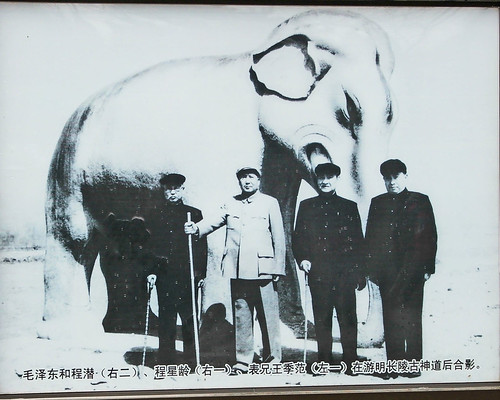

Mao was here


Friday, 4 March 2011

Ships made in Japan

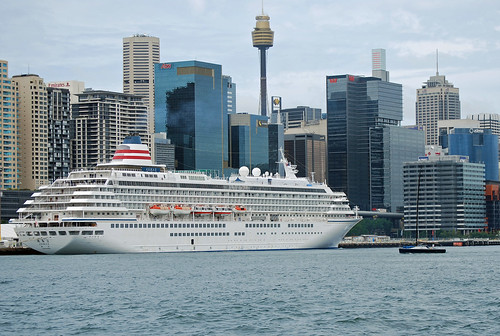
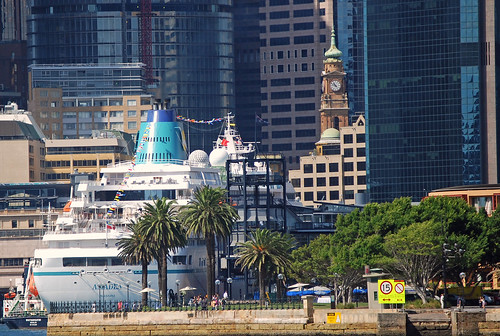
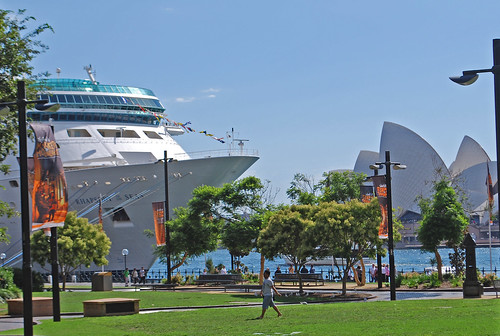
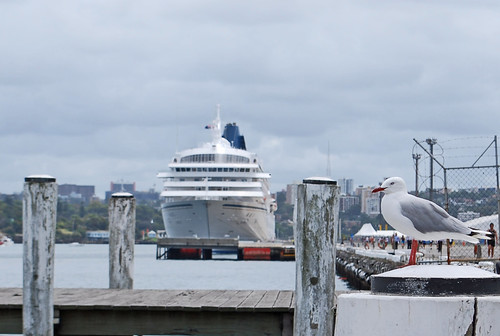
On 15 February we had a visit from MS Asuka II ( 飛鳥II ), operated by the Japanese line Nippon Yusen Kabushiki Kaisha (日本郵船株式会社). She was on a Pacific cruise from Yokohama and Kobe and return.


Asuka II


The ship has an interesting history: she was built at the Mitsubishi yard in Nagasaki in 1989.

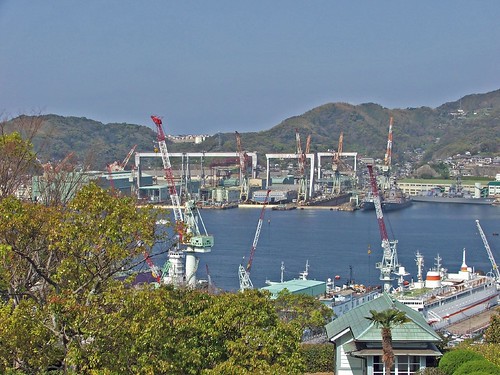
Mitsubishi Heavy Industries shipyard Nagasaki.

She commenced service in 1990 as MS Crystal Harmony for Crystal Cruises. Crystal Cruises is owned by Nippon Yusen.

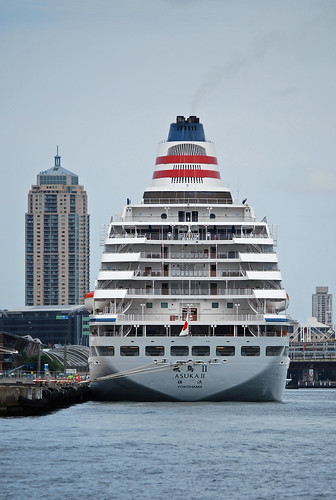
Asuka II

In 2006, the ship was renamed Asuka II under current ownership. Asuka II has a gross tonnage of 50,142; and is 241 metres long.

Asuka II

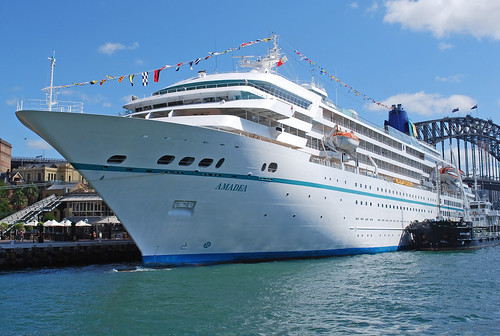
The name Auska II suggests a first Askuka, and she is still afloat under the name Amadea. The first Asuka ( of current times: there were earlier ships of this name) was also built at Mitsubishi in Nagasaki, and commenced service in 1991. In 2006 she was sold to Amadea Shipping Company and is operated under charter by the Germany-based Phoenix Reisen. She also visited Sydney this year and was at the Overseas Passenger Terminal on 26 February.

Amadea

Amadea has a gross tonnage of 28,856, and is 193 metres in length.

Amadea
Her itinerary would suit those who like to spend some time at sea: she departed Nice on 22 December 2010 and travelling around the world from west to east will arrive in Hamburg on 7 May 2011. The itinerary gives an indication of the many and varied ports accessible to smaller cruise ships.

Amadea

( Facts in this post come from wikipedia and are hence as accurate as the wiki. )

Sunday, 6 February 2011

Shipping News for 5 February 2011

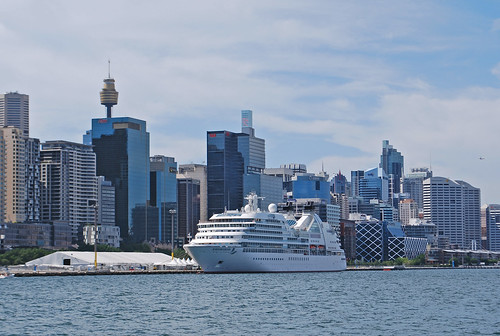
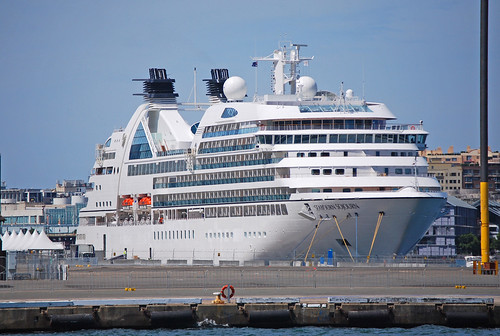
Seabourn Sojourn

This weekend Seabourn Soujourn made her first visit to Sydney. Her maiden voyage was in June 2010, and she is one of five ships of this line.

The ship has length of 198 meters; beam 25.60 meters and a deadweight tonnage of 32,000 metric tonnes.

I think this makes her similar in size to the old P&O liners Arcadia (219.9 m; 27.6m) and Iberia, though I am completely confused by the changes in measurement to the mass of ships. ( I know the displacement of ships I saw 50 years ago but the changes in measurement make comparison difficult. )

Et in Arcadia ego

The Seabourn Sojourn, however, carries only 450passengers, less than half the number on the Arcadia.

Seabourn Sojourn

She was berthed at Wharf 5 Bangaroo: a new name for the former Darling Harbour terminal.

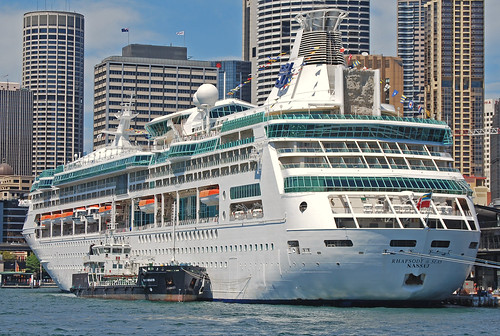
Rhapsody of the Seas


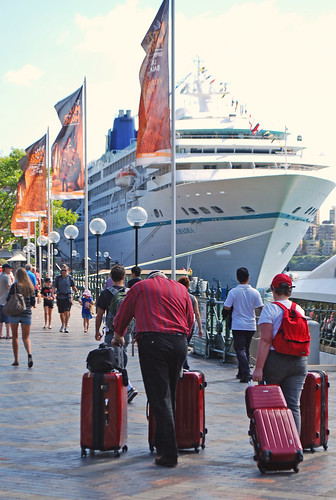
Rhapsody of the Seas was also in Sydney on 5 February; berthed at the Overseas Passenger Terminal, Circular Quay. She has been coming and going from Sydney all this summer.

Rhapsody of the Seas

Rhapsody of the Seas has operated since 1997. She is one of 42 ships operated by Royal Carribean International. The ship as a length of 279 metres; beam 32.2 metres and a Gross Tonnage of 78,491 tons. This makes her a little smaller than Cunard's Queens Victoria and Elizabeth. So maybe a little more crowded with 2435 passengers.

Thursday, 6 January 2011

Geoffrey Rush: The King's Speech and The Diary of a Madman


It was fascinating to see Geoffrey Rush in a film and on stage in the same week.


I don't see many films and can't easily compare The King's Speech with other recent releases but it is reported to be in line for major awards this year. Apart from thinking it was perhaps twenty minutes over long I enjoyed it, though not as much as Deborah Ross who wrote in The Spectator "... I love it so much that, if I could, I would take it home and put it down for a good school and wrap it up warm in the cold and, should it catch a chill, I would nurse it and offer hot lemon and maybe even oxtail soup...". In fact, I am surprised that such an old fashioned and low key movie is so well received; but, as I said, I haven't seen the others.

The King's Speech is about the relationship between the Duke of York, later King George VI, (Colin Firth) and, Lionel Logue, an unorthodox Australian speech therapist (Geoffrey Rush). The Duke had a very bad stammer and was unable to speak effectively in public. He engaged Logue to assist him at a time when events leading to the abdication of Edward VIII and his own accession to the throne made his ability to cope with the impediment all the more critical.

Colin Firth mastered the stutter, and the accompanying frustrations and outbursts of temper very well. Geoffrey Rush's portrayal of Logue was very restrained, you could say underplayed, depicting an otherwise very ordinary man with a particular gift going about his work almost unaffected by the status of his royal patient. As a former and failed actor, Logue was a slightly unconventional father to his growing sons. There was a silent but brilliant flash in his portrayal when, on the outbreak of war, Logue looks at his elder son and realises, I think, that the boy may become a victim of the conflict.

His acting was in great contrast to his Aksenth Poprishchin in The Diary of a Madman at the Belvoir Street theatre and the comparison shows the great range of his talent.

If Geoffrey Rush's acting was restrained, you could say the same of the whole film which avoided the clichés of royal costume drama, particularly in the music. The film has an original score by Alexandre Desplat. But, interestingly, towards the climax, the King's first radio speech of the second world war, Beethoven was heard. A slow measured passage which I found came from his 7th. symphony. Royalty and Empire usually demand Elgar, who was absent, and the King's coronation, seen as a black and white newsreel being watched by the participants, could have had Walton's coronation march Crown Imperial which was written for the ceremony, but may have been thought too grandiose for the established mood.

And then to Belvoir Street for The Diary of a Madman. This play was written and first performed by Geoffrey Rush at Belvoir Street in 1989. It's revival marks the retirement of its director Neil Armfield as Artistic Director of the theatre. The play is based on a short story by Nicolai Gogol (1809 - 1852), adapted by English playwright David Holman with Neil Armfield and Geoffrey Rush.

We have all heard of Gogol but is he known than read? The story is in the form of a diary by a member of the lower orders of the Russian civil service. We first learn that, like many in structured organisations, such as schools and some parts of the legal profession today, he is both trapped in and fascinated by the intricate hierarchy of which he is an insignificant member.

 "I'm only forty-two, that's an age nowadays when one's career is only just begining. Just wait my friend, until I'm a colonel or even something higher, God willing. I'll acquire more status than you."

Then, in the most innovative part of the story, he hears a conversation between two dogs, which doesn't surprise him over much as he had read of cows asking for a pound of tea in a shop. He then claims to have tracked down some letters between the dogs and relates their content in some detail. Finally, on reading that the throne of Spain is said to be vacant, he realises that he is the King of Spain; and mistakes the men who come to take him away for the royal entourage. If there is a fault in the narrative, it is that the final delusion appears from nowhere. It doesn't seem to develop smoothly from the character's illusions about the dogs, or his hopeless infatuation with a woman well out of the reach of a junior clerk. You might say that it was an appropriate delusion for a man obsessed with position and rank, but it happens suddenly nevertheless.

The story was written as a satire on aspects of Russian life at the time: such things as a quotation from an obscure poet Poprishchin wrongly attributed to Pushkin, a contemporary newspaper nicknamed the Little Bee, and the sharpening of quills in goverment offices - in which Poprishchin takes such delight -and which a note to the Penguin edition of the story tells us was, unsurprisingly, the responsibility of the most minor clerks. However, all this is similar enough to aspects of modern life not to matter much.

The story as written is ready made for adaptation for the stage. Although in the form of a diary, the writing quickly jumps into what must be intended to be read as the stream of Poprishchin's thought rather than a transcript of his diary; so it translates very well into a monologue for the theatre. The adaptation  includes large sections of the story unaltered.

The Blevoir street theatre is unusually configured with banks of steeply raked seats looking towards the stage which is in one corner of the space. It's similar to, but not quite a thrust stage. The amazing thing about it which we noticed as soon as we came in was the way in which this unpromising space is transformed by each set built in it. The set for The Diary of a Madman depicts  Poprishchin's decrepit but brightly painted attic bedroom. It's so different from the very modern hotel room on a revolving stage used for Measure for Measure that you immediately feel you are in a different place.

The play cleverly adds a context for the narrative of the diary by placing Poprishchin in the attic attended by Touvi a faithful Finnish servant, charmingly portrayed by Yael Stone, who also takes two other minor roles. However, it soon moves into the diary itself.

Geoffrey Rush depicts an engagingly eccentric man, whose first steps into another world - his contacts with the talking a writing dogs - are almost believable. There is a little improvisation, including some interaction with the musicians, which is never allowed to detract from the narrative. The performance is very physical; seemingly out of control at times. Gradually the character collapses, so that by the time he reaches an asylum he is a grotesque and frightening figure. A truly remarkable performance.

Postscript added 12 March 2011

Since this was written Geoffrey Rush has missed out on the oscar for best suporting actor for The King's Speech and Diary of a Madman has opened in New York: here are reviews from the New York Times and The New York Review of Books.


Tuesday, 30 November 2010

French Connection

Chance events can provoke an interest; and it was the appearance of Pascal and Ami Rogé at the Australian Festival of Chamber in 2005 and 2006, together with a chance encounter with them in New York that encouraged me to fight jet fatigue and attend Pascal Rogé’s concert at the Queen Elizabeth Hall on 29 April.


It was also fortunate that the day prior to the concert the Rogés appeared on In Tune on BBC Radio 3. This discussion was valuable not only in getting an understanding of the concert program, but also for the information that, following their performance of a work by Matthew Hindson at the Townsville festival, which I must have heard but am unable to recollect, the Rogés commissioned him to write a concerto for two pianos which they will perform with the Sydney Symphony next year. I have always enjoyed hearing Matthew Hindson’s music. My forgetfulness is related not to the quality of his music but the difficult task of bringing newly heard new music to mind after a single hearing.

When I learned of the new work I thought that Matthew Hindson’s usual fast pace and rhythmic drive will make for a very exciting concerto. I have since heard his short piece Beauty, written for the anniversary of the Australia Ensemble, and his 2010 work Light is both a Particle and a Wave. Beauty is not manic at all, I found it very moving, I don't know if he has achieved this kind of thing in any earlier compositions or if it's an new development for him, but whatever the answer, I now like his music more than ever. There are also some excellent contemplative passages in the second movement of Light... The awful thing is that if I travel as planned, I will not be here in Sydney when the concerto is performed in May 2011.

Of the concert itself, Pascal Rogé said that he designed the program to make the case for Chopin as a French composer. Chopin’s mother was French and he spent 15 years in Paris. He also wanted to show Chopin’s influence on the French composers who followed him Fauré, Ravel, Poulenc and particularly Debussy.

He says in the program:

I have interwoven the Chopin pieces with those of the other composers with hardly any pause between them, moving from one to another, as if walking from one artwork to another in a gallery. In this way, I was able to make connections between the works, and we could transport ourselves into a journey of sounds and colours.

And this is exactly what happened.

The Queen Elizabeth Hall was packed, with part of the audience seated right alongside the piano on the stage. By great good luck when I booked on line at the last minute about the only seat available was in the front row; a wonderful place to be for such a marvellous concert. Pascal Rogé played with an intensity I didn't see at Townsville, and there was, as promised, almost no pause between the works.

I have never been a great follower of Chopin, but I suppose I became familiar with his music by a kind of osmosis by hearing it from time to time on the radio and such. Almost all of the music was familiar to me, and the argument about the connection between Chopin and the French composers seemed unanswerable. Among the French pieces was The Girl with the Flaxen Hair, which has been known bring me to tears, which it did again.

The influence of Chopin cannot have been direct: none of the French composers can have known or heard him. Fauré's dates are the only ones with a small overlap:

Chopin 1810 - 1849

Fauré 1845 - 1924

Debussy 1862 - 1918

Ravel 1875 - 1937

Poulenc 1899 - 1963

so the selection gives some idea of the dominance Chopin's music must have had in Nineteenth century France.

Pascal Rogé made a recording of many of the pieces played in the concert last year, and I have now bought one. There is only one CD, so some of the pieces played in the concert are omitted. Having heard the concert, listening to the recording was a special experience for me, but I'm sure most would find well worth hearing on its own.


International Piano Series Queen Elizabeth Hall London 29 April 2010.

Tuesday, 5 October 2010

Das Rheingold


I am determined not to become a Wagnerite. It's not that I don't like Wagner - or The Ring; but there is so much more music to hear and enjoy. George Bernard Shaw wrote:

It is generally understood, however, that there is an inner ring of superior persons to whom the whole work has a most urgent and searching philosophic and social significance.

That was in 1898 and they are still around, only now they take to the air themselves and congregate on rocky outcrops wherever a Ring cycle is performed. I have no wish to join them.

But I have bought a ticket to the Met's new Das Rheingold on 2 April 2011 ( as well tickets to all kinds of other things ). And at the risk of seeming obsessive, I am approaching this occasion by stages. First, I was able to hear the opening night of Rheingold streamed on the Internet. And before long I will see it in the cinema - though not live in my time zone.

The Met has invested large sums in the technology required by Robert Le Page's production. An early version of it was deployed in his Damnation of Faust, which I saw in the theatre in 2008 and 2009. When I first saw it I wasn't much taken with the visual effects and thought that the strength of the production was the playing of the Met Orchestra. But on seeing it again, I changed my mind and found the staging to be very effective. The physical part of that staging was a scaffolding like structure at the front of the stage. The structure for the Ring is much more complicated. Some of it didn't work on opening night.

I live in a critical desert where inane and decaying newspapers sometimes manage to print 250 words about a show. The Met is more fortunate and the piece I heard streamed attracted many writers, most of whom were given the space to say something of interest.

There are more but I have seen:

The New York Times
The New York Post
The Washington Post (Associated Press)
The Times
The Financial Times
The Daily Telegraph
The Guardian &
Daniel Stephen Johnson

though some of the links my die with time.

As heard on line, it sounded wonderful. Even at a distance and though medium fidelity speakers the orchestral sound was overwhelming. No explanation is required for the reception the audience gave to James Levine.

As a dedicated non Wagnerite, I was a little disappointed to find how familiar the music was - even after a long break. The singing seemed uniformly excellent and I did not feel at all deprived in not being part of the magic on stage.

The critics confirmed my hearing of the orchestra at a distance:

The true star of the night though was James Levine, who stood through his first full performance at the conductor's podium for seven months due to a serious back complaint. As he has done so often over the past 40 years at the Met, he inspired a great orchestra to give of its best, culminating in a mesmerising climax. The Guardian

Almost as if determined to prove something, he conducted the score with exceptional vigor, sweep and uncommon textural clarity. New York Times

But what chiefly galvanises the drama — as so often at the Met — is the quality and power of the orchestral playing under James Levine's painstaking direction. The Times

The production worked for some ...

Lepage treated the audience to a mesmerising display of virtual magic, giving them plenty to feast their eyes on in the intimate scenes between the coups de théâtre. Telegraph

...keeping the gadgetry low-key and respectful and intelligently enhancing Wagner's mood rather than imposing his own. Guardian

but there were also mixed feelings  ...

For the most part it was an impressive success: an inventive, fluid staging and a feat of technological wizardry that employs sophisticated video elements without turning into a video show. Wagner buffs tend to be a fanatical sort, and no doubt there will be debate about Mr. Lepage’s work. Here he received a mostly enthusiastic ovation with scattered boos. I had mixed feelings. New York Times

and a craving for Eurotrash which I find hard to fathom:

Forget meaningful symbols or sociopolitical undertones. In New York, a tree looked like a carefully painted tree in a canvas forest. The principals struck traditional poses, modelled quaint breastplates and winged helmets. This was no thinking-person’s Wagner, but it made a lot of conservatives happy. Financial Times

But what's already depressingly clear is that Lepage has virtually nothing to say about the political, social, moral or ecological subtexts of The Ring. You might have thought that, in this of all cities — and after everything that has happened in the past two years — a tale about the corrupting lust for gold would be staged with a modicum of irony, if not outright satirical venom. The Times

Until converted, my opinion is that productions should by and large be faithful to the composers' intentions and that the universal appeal of myth isn't enhanced by narrowing its scope.

I remembered Wotan as a overbearing figure declaiming about this and that in a way which relied on the subtlety of the orchestral accompaniment for texture. I have heard Bryn Terfel's powerful voice but unlike some critics have not been impressed by his acting. On both counts I was surprised to get the impression of a conversational, domestic Wotan with excellent variation in his tone and delivery. The critics were divided:

The formidable bass-baritone Bryn Terfel sang his first Wotan at the Met, a chilling, brutal portrayal New York Times

Bryn Terfel, making his US debut in his celebrated role of Wotan, the lord of the gods, was brooding and dark. Guardian
The Welsh bass-baritone Bryn Terfel was riveting as Wotan, playing him as a vigorous, hot-tempered god, full of youthful pride and daring. Vocally, he was overpowering, ringing top notes alternating with gently modulated phrases. Washington Post

Not even Bryn Terfel, who hurls out Wotan's lines with customary verve (though edging nervously sharp on some big notes) but musters only a fraction of his usual charisma. For once the big Welshman seems overawed.  The Times

More problematic was bass-baritone Bryn Terfel in the central role of Wotan, king of the gods. He deployed his world-class voice with skill, but when the score called for rich, flowing sound, he tended to yell and go sharp. A stringy wig concealing half his face blunted his usually razor-sharp acting. New York Post

Eric Owens' Alberich was amazing. My memory of Alberich was of a cringing and unattractive dwarf, a typical bully, tormenting Mime as an outlet for his own rage. Again there were two surprises: the audio stream revealed an Alberich as powerful as Wotan, their dialog resembling a prize fight. And having heard Eric Owens as General Groves in John Adams' Doctor Atomic, I didn't expect such a strong performance. The portrayal of General Groves as a figure of fun, probably done to give some variety between the characters, was about the only thing that annoyed me about Doctor Atomic and this may have affected my appreciation of his singing.

Everyone loved him:

And the bass-baritone Eric Owens had a triumphant night as Alberich...Mr. Owens’s Alberich was no sniveling dwarf, but a barrel-chested, intimidating foe, singing with stentorian vigor, looking dangerous in his dreadlocks and crazed in his fantasy of ruling the universe. New York Times

I guess part of the reason I was uncomfortable is that Alberich, in this production, is not the stupid little clown we're used to seeing; in fact, he's fucking terrifying. Johnson

A vocal standout was Eric Owens, whose bass-baritone retained its essential beauty and heft even in Alberich’s moments of rage. New York Post


Another distinctive feature of the audio was the Loge of Richard Croft. My memory is of Loge sung by a wispy high tenor; and I enjoyed the much richer sound I heard here. Loge was only mentioned in passing by the critics and perhaps my strong impression came from the broadcast medium: he may not have sounded as strong in the theatre:

...tenor Richard Croft made for a lively Loge, perhaps lacking quite enough volume to rise over some of Wagner's orchestration. Washington Post

I also enjoyed the creamy mezzo soprano of Stephanie Blythe as Fricka, and so did the New York Times:

the powerhouse mezzo-soprano Stephanie Blythe was a vocally sumptuous, magisterial yet movingly vulnerable Fricka.

Watch this space for Das Rheingold parts 2 and 3.

Metropolitan Opera New York Internet stream Das Rheingold heard Tuesday 28 September 2010 (local time).

Wednesday, 25 August 2010

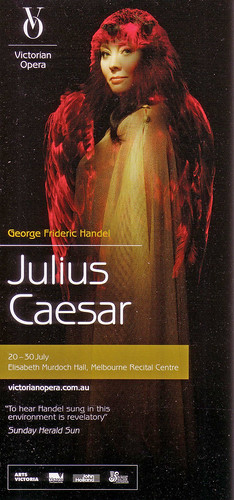
Victorian Opera: Julius Caesar

jc
The second event on my visit to Melbourne was the Victorian Opera production of Handel's Julius Caesar at the Recital Centre. I had been less than enthusiastic about three VO productions heard earlier; and was also sceptical about the use of the Elizabeth Murdoch Hall in the Centre for opera. I'm not critical of the use of a space without a traditional stage: operas staged by Pinchgut Opera in the City Recital Hall in Sydney have been excellent overall and musically outstanding.


However, on my previous visit to the Melbourne hall at the time it was opened in 2009, I heard chamber music, (Schubert's Trout Quintet played by the Goldner Quartet with Piers Lane and Alex Henery and a late night concert which introduced me to Morton Feldman's haunting Rothko Chapel), for which the acoustics of the hall were perfect, and a performance of some opera excepts and Vaughan Williams Serenade to Music, with Orchestra Victoria conducted by Richard Mills and singers, which I thought was not as well suited to the space.
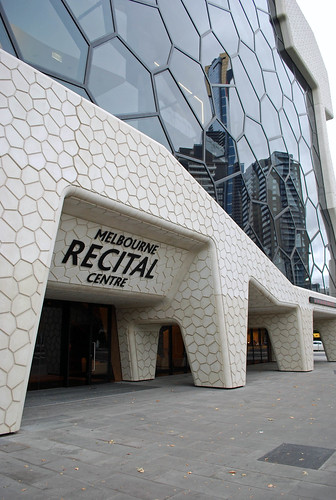
Melbourne Recital Centre

The Elizabeth Murdoch Hall is lined with timber, and I could smell the wood as I came in: I hope this natural aroma therapy will last.

For Julius Caesar, the orchestra was placed in front of the stage. The simple all purpose set included an obelisk, Cleopatra's Needle perhaps, reaching almost to the ceiling and some thin drapes hanging from a rail attached to the roof, which were opened and closed during the performance.

As soon as the orchestra played, my doubts about the quality of the music were extinguished. The ensemble from Orchestra Victoria conducted by Richard Gill, the artistic director of Victorian Opera, played beautifully. The orchestral sound was balanced and well articulated. If I wanted to find fault I would say that the hall was not quite as kind to the singers, as I thought I noticed a little too much reverberation at times. But overall I was enchanted. I should have allowed myself enough time in Melbourne to hear it more than once. So much for scepticism.

I don't think I had heard David Hansen the countertenor who sang Caesar before. He has a remarkably agile voice, his high notes in particular had great clarity of tone. Tiffany Speight was a fine Cleopatra, and it was interesting to hear Tobias Cole ( Oberon in OA's Midsummer Night's Dream earlier this year ) as Tolmeo. He sang Caesar in the most recent revival of OA's famous production. The other singers were excellent as well.

It may not be a universal rule, but I think there is much to be said for staging 17th and 18th century opera in small theatres and halls. I know that when Handel's opera's were first performed the rather static nature of the opera seria was mitigated by the use of elaborate scenic effects; but I'm not certain about how large the theatres were. I have seen the OA Julius Caesar, first performed by Yvonne Kenny and Graham Pushee in 1994, in both Sydney and Melbourne. Those theatres were fine for the music and the space allowed for elaborate and effective staging. I was, however, disappointed by David McVicar's production, originally for Glyndebourne, which I saw at Chicago Lyric Opera in 2007. I will mention some aspects of the production later, but my overriding impression was that the theatre was too large for the work which lacked impact for that reason. It's seen from a distance, and though there are singers who are powerful enough for a large auditorium many fine artists are not. In Chicago, French countertenor Christophe Dumaux, who sang Tolemeo, seemed much more suited to the space than David Daniels, who sang Caesar.

The VO production was directed by Steven Heathcote who recently retired after an outstanding career as a principal dancer with the Australian Ballet. His background in dance was reflected in some aspects of the production, which I thought was well suited to the hall and enhanced the excellent music. I disagree with the critic for the Melbourne Age, who wrote: "All too often, what we were seeing on stage seemed superficial to what was being played and sung."

The static nature of opera seria creates problems for the modern director, but those problems were elegantly solved here. Two examples:

Towards the end of Act 1, Caesar sings the remarkable aria with horn obligato "The skilful hunter treads silently when stalking his prey". In Francisco Negrin's OA production this was done with Caesar and Tolemeo confronting one another around a large table covered with a green baize cloth. It was a thrilling piece of theatre. David McVicar's production picked up a dance rhythm in the music and had Caesar and Tolemeo performing a kind of gavotte which seemed to drain the dramatic tension from the scene. The VO production, with less elaborate resources, depicted the scene as a confrontation in a way which did enhanced the music.

Another highlight of the OA production was the aria -

" If in the pleasant, flowery meadows, the bird among flowers and leaves, conceals itself, it only makes its song more delightful.."

in which Caesar steps out of character and conducts a kind of duel with the accompanying violinist as they compete to find the highest note. This was also very effective in the theatre. (The applause and foot stamping can be heard on the live recording ).

Chicago also had the violinist on stage without the same theatrical effect, but Steven Heathcote's solution was to have a dancer depict the bird of the lyric sometimes eluding Caesar's reach but when caught allowing the singer to try a few lifts from the ballet. It created a nice effect.

Apart from the obelisk, the Melbourne production was not intended to accurately represent Caesar and Cleopatra in their historical context, but it was straightforward and effective. The much more elaborate Chicago production was a sly representation of British Imperialism, which despite the comic effects had a Serious Purpose. Mr. McVicar says in the program: " On some level this is an opera about what happens when you walk into other people's countries under false pretenses". So there.

I find that it is now 40 years since I first heard Julius Caesar. I mention this because over that time there has been a change in the performance practice for opera seria, most of which included parts for the then prevalent castrati. I saw the first stage performance of Julius Caesar in Australia presented by Young Opera at the Science Theatre, University of New South Wales. Ceasar was sung by one of the great Australian singers, contralto Lauris Elms and Cleopatra by the equally celebrated Marilyn Richardson. Here is the cast list:

1970 Caesar

As with many programs there is no indication of the year, but looking in Lauris Elms' memoir The Singing Elms I find it was 1970. She says (at the time of her writing): "Twenty-five years later people still remember those performances." And Forty years later as well.

Alfred Deller's career as a countertenor was well established by then, but the voice did not have the prominence it does today. I bought a LP record of highlights of the opera as performed by New York City Opera after hearing it in 1970. Beverly Sills is Cleopatra, but Caesar is sung by a bass baritone, Norman Treigle.

As late as 1999, we have a female Caesar at the Met, in a performance I found on the Met Player:

Jennifer Larmore and Sylvia McNair as the ill-fated couple, abounds with dazzling vocal pyrotechnics as well as heart-rending drama. Stephanie Blythe (Cornelia) and David Daniels (her son Sesto) give memorable performances as the grieving family of the murdered Pompey. Brian Asawa sings Cleopatra’s conniving brother Tolomeo.

I was surprised to see David Daniels, Caesar in Chicago, was Sesto. In 1970 David Parker, a tenor, sang this role, but in the other productions I have mentioned Sesto has been sung by a contralto.

* Julius Caesar, Victorian Opera at Melbourne Recital Centre; 22 July 2010.