Friday, 15 August 2008

TSUGARU

One way to revive this Wandering is to post a note from Saturday, August 19, 2006

On 18 August, C and I went to the City Recital Hall to see TSUGARU Soul and Beat of Japan. Tsugaru is the northern part of Honshu and the Tsugaru straight lies between Honshu and Shikoku. The Tsugaru shamisen is a kind of shamisen or style of playing which started there. I first read of Tsugaru shamisen music and its origin in the playing of blind itinerant musicians in Alan Booths Looking for the Lost. He tells of a short lived boom in Tsugaru shamisen music in the 1970s.

The leading artist at the concert was Tsugaru shamisen virtuoso Michihiro Sato. His son Michiyosi, who graduated from High School in 2005, also plays the shamisen. Sachiko Kaiho, a Koto player is Mr. Satos wife and Michiyosis mother. Shozan Tanabe played shakuhachi; he had only one large instrument. (My introduction to the shakuhachi was Riley Lee's playing at the Townsville Festival of Chamber Music in July and he had many instruments of various lengths.)

Masaki Yoshimi played tabla, which he studied in India. Im uncertain at the moment how the tabla came into a Japanese group, or whether its use in ensembles of this kind is common. He was the only player who did not wear Traditional Japanese dress. Sachiko Kaiho wore a bright green kimono, and the colour of Mr. Satos jacket marked his seniority in the group.


Mr. Sato spoke in English from notes from time to time. An endearing feature of his speech was the pronunciation of works like shakuhachi which became shak-hashhhhh; Michyoshi michiyoshhhhhhh and so on, just as in the days before recorded announcements words like Nihonbashi became Nihonbashhhhh for train guards.


The family group was larger. The father and son were listed as playing Tsugaru Shamisen Kyokuawase together, but when we reached it Mr. Sato announced Tonight we have a special surprise for you my youngest son will play with his older brother! He looked about 4 years younger than Michiyoshi.


The program notes say that the sounds of the Tsugaru shamisen are notably different from more traditional Japanese music. They are played with a large plectrum held in the closed hand. It is used make drumming sounds on the body of the shamisen as well as to pluck the strings. The younger Sato seemed to make more drumming sounds than his father. When they played together there was great empathy between them.


The music has been compared to jazz and there are obvious parallels, but I was unable to tell what improvisation was and what was not. I am unfamiliar with the music. There was a lot of fast complex fingering in the left hand in some parts but although the sound was distinctive some of the tunes were a little elusive. The most prominent feature on hearing it for the first time was the rhythms. Some were very fast and exciting to hear. There were some vocalizations but no singing mostly shouts and crys at a climax. In the last item, the tabla player accompanied his solo with very fast wordless vocals which resembled scat singing in jazz.


I would like to investigate further but I havent found any available CDs of this or similar music as yet. Still there are places in Japan where it is played and I can search for these on my next trip.

There is some information on wikipedia http://en.wikipedia.org/wiki/Tsugaru-jamisen


The web page for the concert itself is http://www.jpf.org.au/02_events/tsugaru/tsugaru.htm


Please let me know of anything more you know: specially cds.

Monday, 5 May 2008

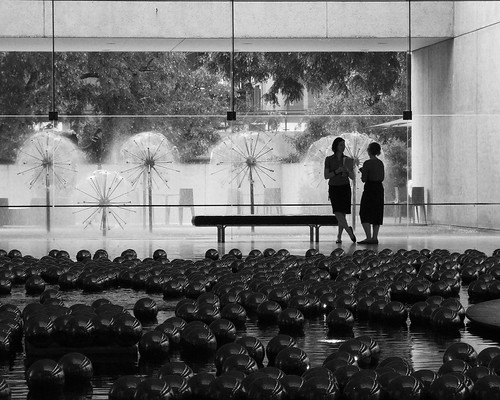
Narcissus garden


Narcissus garden, originally uploaded by Ninoxowl.

(Revised 6 September 2009)
I visited Brisbane for a commercial purpose but went down to the Queensland Art Gallery as well, mainly to see the exhibition Mountains and Streams, since I am taking an interest in Chinese Art at the moment by attending the lectures Literature and Legend at the Sydney gallery. The lectures on Chinese Art are part of series which moves on to Japanese Art later. I thought the Chinese lectures would be a useful prelude to the Japanese ones but despite their variable quality I found much interested in the history, art, and literature discussed. I found I had seen Mountains and Streams previously at the NGV in Melbourne where it originated but had almost no memory of it, attributable, I think, to my complete ignorance of Chinese art when I first saw it. So I saw it again with a little more insight.

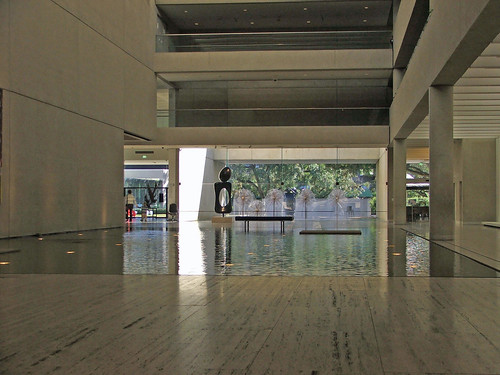
But the highlight of my visit to the Queensland gallery was my discovery of Yayoi Kusama, a Japanese artist whose installation, Narcissus Garden, is a striking feature of the gallery itself. The Queensland gallery is new. I found it to be a splendid large and open space very well designed for the display of painting and sculpture.

The installation by Yayoi Kusama is a version of a work which she first showed in 1966 at the Venice Biennale; or rather outside it, since she had not been invited. It was a very effective action and brought attention not only to herself but also to the way in which official displays of modern and inventive art soon become as ossified and bureaucratic as anything else. At the Biennale Kusama first offered the individual mirror balls for sale at $2. When she was somehow prohibited from doing this she gave out leaflets praising her own work.

Other versions of this work have appeared in the Serpentine in London and the small boat lake in Central Park, NYC. From photographs, it seems that the mirror balls were set out on the grass when they first appeared at Venice but subsequently floating in water. The essence of the installation is the reflective balls themselves. It looks from photographs as if their surroundings at Brisbane have changed a little from time to time; and in other places they seem to be out of reach and more clumped together in the waters and lakes in which they are floating.

In Brisbane the accumulation of balls looks simple and elegant and attracts attention by the constant movement helped along by the notices calling for them to be touched gently.

Narcissus garden

I find that Kusama has been an influential artist for 50 years. She was born in Matsumoto in 1929 and traveled from Japan to the USA in 1958. She was soon in New York where she was active in painting, sculpture and the organization of happenings for some years. She was therefore involved in making installations and other similar works when the concept was truly innovative and she was able to work with originality and flair. It may still be possible to do this, but the passage of time has made so many of such things seem mundane and derivative.

Although not apparent in Narcissus Garden, Kusama has described her work as emerging from her mental illness: she says has had hallucinations since she was a child. She also says that her ability to produce artistic works is a therapy for her.

Kusama often appears in photographs of her work. In a picture of the installation at Venice she is seen lying on the ground amongst the metallic balls in a red jumpsuit. In more recent photographs she poses staring intently at the camera. I wonder about the border between mental illness and self promotion.

Or could it be a characteristic of Japanese artists who move to the west. I am reminded of the self portraits of Fujita staring languidly from the picture; and of his self promotional antics in Paris in the 1920s.

And I can now add Masami Teraoka whom I discovered in Melbourne even more recently. His MacDonald's Hamburgers Invading Japan / self portrait shows the same trait:

http://en.wikipedia.org/wiki/Image:Teraokaselfportrait.jpg

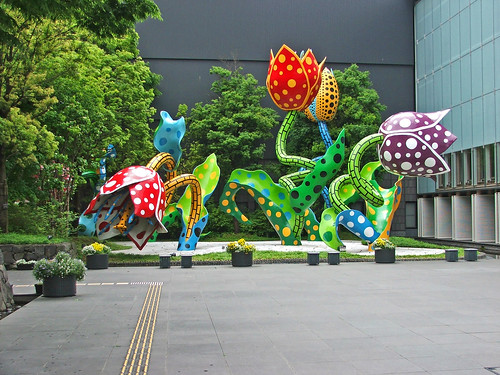
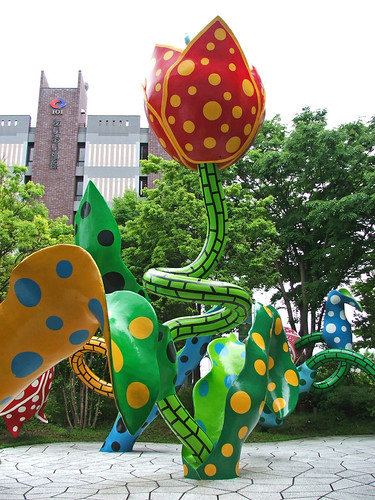
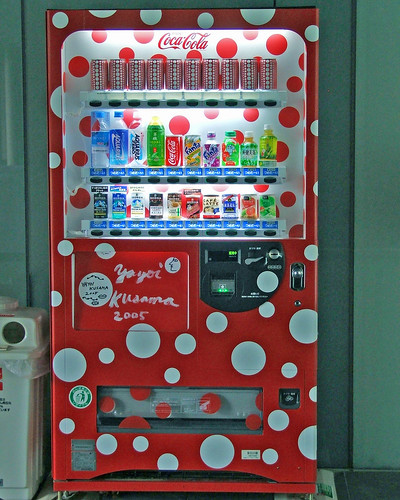
And so it was that in late May 2008, I made my way to Matsumoto, taking the super wide Shinano via Tsumago/Nagiso. I enjoyed my brief visit to Matsumoto. I missed a special retrospective exhibition of Kusama's work by only a week or so. However, as Matsumoto is her home town, the Matsumoto City Museum of Art maintains a permanent exhibition of her work. In fact, her Visionary Flowers (2002) dominates the front of the building; I imagine it was made for the site as the museum opened in that year.


Yayoi Kusama

Yayoi Kusama

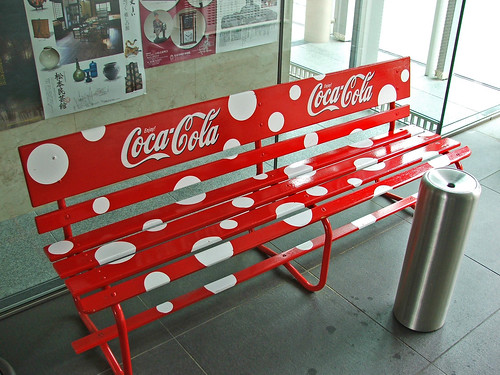
There is also a chair and a drink machine.

Yayoi Kusama

Yayoi Kusama

The display inside was dominated by walk though rooms or installations with mirrors and other special effects. I was the only person in the gallery and was able to enjoy some of the illusions without interruption. The exhibition included some of Kusama's early work, completed prior to her departure for the USA in the late 1950's. The quality of these mainly figurative pictures was impressive. Her later more innovative work was produced on a firm foundation. She is a true innovator: her style developed in the late fifties and sixties; but she denies the influence of modernist movements on her work:

" I had nothing to do with Surrealism, I painted only as I wished"

"...I am not concerned with Surrealism, Pop Art, Minimal Art, or whatever, I am absorbed in living my life."

( Interview in Yayoi Kusama, Phaidon,2000, at 10 & 16.)

In June 2008, I returned to Brisbane and the gallery there:

Missing Narcissus

Narcissus Garden had vanished. I made some enquiries and found that it had been taken down only few days after I saw it.

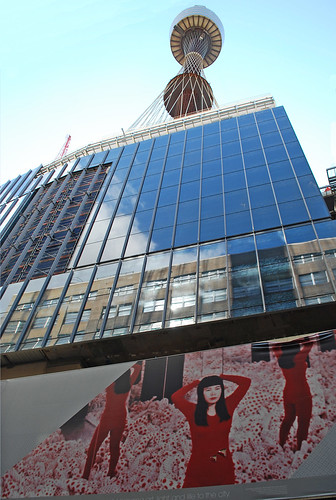
Then in 2009, there was an excellent exhibition of Kusama's work in the Museum of Modern Art, Sydney. No Narcissus Garden but some mirrored balls were lying about. This show also included some walk in mirrored rooms. I did not have them to myself here however. There was a queue for entry to one of the rooms, to which viewers were admitted a few at a time for a minute or so. This exhibiton had a public face with Kusama banners and hoardings all around the city. The exhibition is closed but some of these remain to remind us...

yk


http://www.yayoi-kusama.jp/

Friday, 2 May 2008

AURORA

On 18 April we heard a concert associated with the Aurora Festival, at the Music Workshop Conservatorium of Music. There were three works on the program.
First, Gavin Bryars, One Last Bar then Joe Can Sing (1986). I was reminded by the program notes that Gavin Bryers is best known for Jesus Blood Never Failed Me Yet (1971) which I remembered as a tape loop of a frail voice intoning the words of the title. I don't know if I ever heard the whole piece which the note said ran for an hour, or if my vague memory of it did it justice, but it made me a bit apprehensive.

One Last Bar is written for a large percussion group, 5 players in all, including marimba and vibraphone and what looked like temple bells or small Balinese gongs. Towards the end the bells and the vibraphone were played with a bow.
The piece has a program of sorts: the program describes the title as “an amalgam of in jokes between the composer and himself". More reason for apprehension.
But the overall effect of the work was excellent. A visual metaphor that came to mind was that it created pools of sound. I didn't quite reach the reverie promised by the program note but headed in that direction. This impression was so strong that I was surprised when I re heard the work on the radio a few nights later to hear the characteristic repetitions of the minimalist style were so prominent.
Next was Micrographia by Michael Smetanin, head of the Composition and Music Technology Unit at the conservatorium. I hadn't previously heard of him or his work. Micrographia is scored for piano three violins, cello, bass, flute, oboe, clarinet, bassoon (& contra bassoon) trumpet, trombone, two horns and percussion. The percussion included two marimbas played with the hands rather than mallets or sticks. This work, in contrast to the first, created a sound pattern which seemed to make threads of music against a background of patterns of sound made by various combinations of instrumental sound which were fascinating to hear. The title of the piece comes from a reference to the microscopic work of Robert Hooke, and the gradual expansion of a phrase which begins the work. I didn’t hear this happening at the concert but it was apparent on listening to the broadcast. Yet another example of the need to hear works more than once – if only there was enough time.

The last work was the Daniel Variations of Steve Reich composed in 2006. The work is a musical tribute to the journalist Daniel Pearl who was murdered in appalling circumstances by terrorist thugs in 2002. For a long time I have thought that some historical events are so dreadful that they defy reproduction in artistic work and make it almost impossible for the artist, writer of composer to avoid making the impression that the subject was chosen just to shock and enhance the status of the artist, in a way which wrongly makes use of the victims.
The Daniel Variations overcomes this problem completely. It is a remarkable and very moving work.

It is scored for 4 pianos, a string quartet, 2 clarinets, percussion including two vibraphones and a quartet of singers. The singers voices are amplified, and it seemed at the performance that this was done, at least in the first part of the work in a way which restricted the dynamic range of their singing. The work is also in the minimalist tradition, each movement incudes numerous repetitions of a single line, two taken from the Book of Daniel and two from the words of Mr. Pearl himself. These lines are also the titles of the movements.
1. I saw a dream. Images upon my bed & visions in my head frightened me
2. My name is Daniel Pearl
3. Let the dream fall back on the dreaded
4. I sure hope Gabriel likes my music, when the day is done.
Four grand pianos in a single performance space is worth seeing – and hearing; the sound produced by the unique combination of instruments was fascinating and powerful.
The vocal line in the last movement, I sure hope Gabriel likes my music, when the day is done, comes from a remark recalled by a friend of Daniel Pearl, who was a violinist, about his belief in a heaven.
The setting of these words makes them a powerful affirmation of Pearl’s life and memory and a magnificent defiance of the evil which overcame him.

Aurora Live Modern Music Ensemble Daryl Pratt, conductor. Conservatorium Music Workshop 18 April 2008

Broadcast - same program recorded at Penrith 20 April - ABC FM 22 April

Friday, 21 December 2007

Kisho Kurokawa

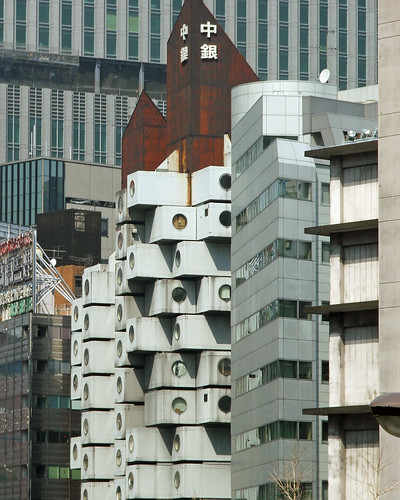
中銀カプセルタワー,


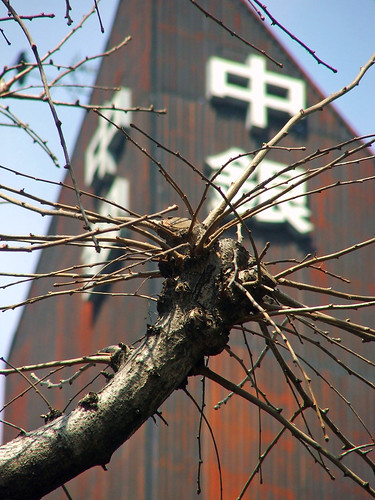
This morning the Sydney Morning Herald contained an obituary of Kisho Kurokawa, the Japanese architect who died on 12 October this year. I find it a sad fact that it’s only when an obituary is published that I can gather together various things of interest about a person. In March 2005 I took some photos of the building in Tokyo which I now know to be Nakagin Capsule Tower.

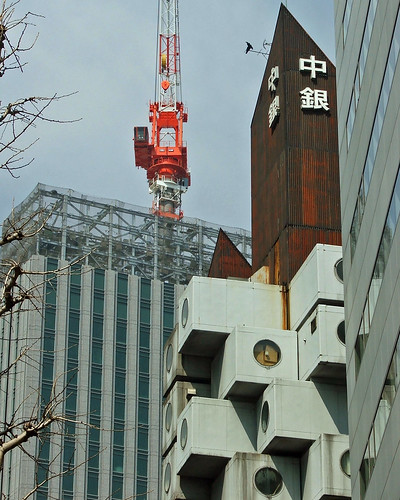
中銀カプセルタワー,

I had vague memories of the history of the building but put the pictures aside without further investigation. The obituary says that Kurokawa thought that people might keep a capsule in the city for the nights when they attended the opera; but it turned out not to be so. As my pictures show the building is a little decayed and one capsule looks as if it is a storeroom for cardboard boxes.

中銀カプセルタワー,


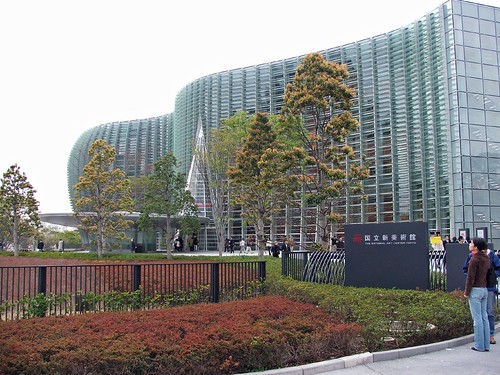
In addition, as I didn't know anything of Kurokawa, and I didn't associate the Nakagin Capsule with the National Art Centre at Roppongi which opened only this year and which I visited in March.

National Art Center Roppongi

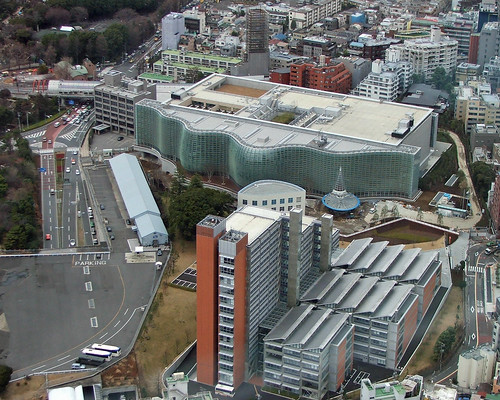
I first saw the building from the Mori Tower in 2006. It was not open and I didn't know what it was:

国立新美術館


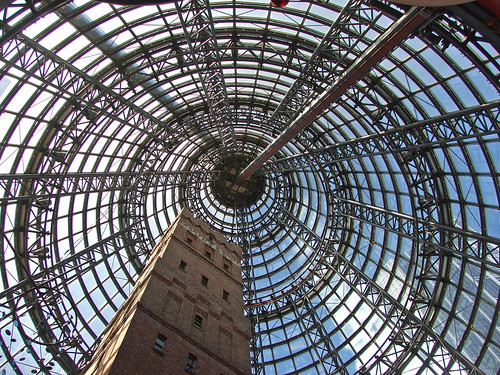
Nor was I aware that Kurokawa was the architect of Melbourne Central, built to house a (now closed) branch of the Daimaru department store chain. The conical glass and steel roof over the mall preserves an old shot tower inside the structure itself. The tower was used to make lead shot by dropping molten lead from the top into water at the bottom. The drops of molten lead solidified as they fell forming the required spherical shape due to surface tension apparently.


Melbourne Central

Tuesday, 13 November 2007

Vanessa

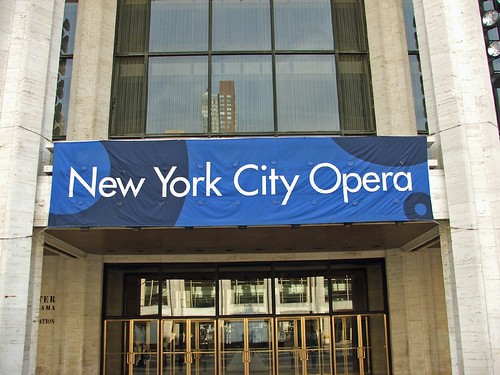
NYCO

I was disappointed with Vanessa by Samuel Barber, which began its season at the New York City Opera on November 5. The production and singing were fine; but I don’t think Vanessa really works as an opera. My immediate thoughts about why this is so relate to the story of the work which is simple enough to tell.

It is set in “a northern country”.
Vanessa has waited 20 years in her house for the return of her lover Anatol.
It is a grand house with many servants.
She lives with her mother, the Baroness, (who refuses to speak to her) and a younger woman, Erika, described as her niece.
Anatol does not return, but his son, also named Anatol, arrives and advises his father is dead.
Anatol seduces Erika who refuses his offer of marriage twice. Erika is pregnant.
Vanessa falls in love with Anatol.
Vanessa and Anatol’s engagement is announced at a party: Erika first faints then runs out towards the lake.
Erika is brought back alive but loses her child.
Vanessa and Anatol depart for Paris; leaving Erika at home with the Baroness who now refuses to speak to her. “It is now her turn to wait”.

Many of the events are mediated by The Doctor, and amiable but self confessedly inept medical man, who may have wandered in from Chekhov.

I think that the problem with the opera is that the story does not make sense as a realistic one. And it doesn’t seem to be an allegory or the retelling of a myth. People, outside of psychiatrists’ case books just don’t behave like this. So there is no believable emotional structure to which the music can attach.

Some accounts of the opera mention without elaboration that there are hints of incest in the story. Thanks to a gentleman in sitting behind me in the theatre who told the world at large about this secretive sub plot I can reveal it here.

Before the arrival of Anatol II Erika asks if she should read to Vanessa. Guess what she reads:

Oedipus: Woe, woe is me,
Sorrowful that I am!
Where am I, where am I going?
Where am I cast away?

Vanessa is dissatisfied with Erika’s reading of this and has her own turn. It is so apposite to Vanessa’s own unfortunate condition. As for Oedipus: did Anatol II kill Anatol I so as to marry his mother?? And while we are at it, is Erika really Vanessa’s niece, or maybe……


All of this may be significant for Freudians; and it could be that the members of the audience at the Met who greeted the first performance in 1958 with a standing ovation were all in analysis themselves.

To me, it just adds to the confusion. When Erika goes missing and is found, Vanessa seems to have a maternal concern for her; but if that’s what it is, it is completely gone by the end. A hard but pleasure seeking Vanessa shows no concern at all for Erika’s plight.

Apparently, Barber was inspired Isak Dinesen's Seven Gothic Tales, and suggested his librettist Gian Carlo Menotti make use of them. The libretto does not adopt any of the stories but draws on The Gothic for inspiration.

Isak Dinesen was the pen name of Danish author Karen Blixen.

A website devoted to her and her work
http://www.karenblixen.com/question101.html
relates:

“Karen Blixen was escorted to the opera on January 7, 1959, by the composer himself and Menotti. However, part way through the performance she pleaded illness and left the theater. Her secretary says, in Notater om Karen Blixen, that Barber was "upset" by her premature departure from the opera. Karen Blixen made no public comment.”


The music which is tuneful but not particularly engaging has many and varied references to other composers and other operas. There are two duets for Vanessa and Anatol II which give plenty of scope to the singers, and which were well sung in this production, but there is a lack of connection. I was not made to care what these cardboard cutouts thought or felt. An essential element of opera went missing.


As I mentioned, the realistic set, the singing and the orchestral playing were good. Richard Stilwell as The Doctor almost stole the show. It was remarkable that The Baroness was sung by Rosalind Elias, who created the role of Erika almost 50 years ago. She had noticeably smaller voice than the others, but was otherwise fine in a role which would have been more taxing had the Baroness been more talkative.

And now for something completely different. Writing in the New York Times, Anthony Tommasini said:

At City Opera, thanks to a simple but effective production by the director Michael Kahn; an excellent cast headed by the soprano Lauren Flanigan, who gives a smoldering portrayal of the title role; and crucially, the urgent and sensitive conducting of Anne Manson, in her company debut, “Vanessa” emerges as an authentic American masterpiece.

I am not persuaded. I wonder if, because of Barber's pivotal role in the development of American music, critics like Mr. Tommasini, want to believe he was a better composer than he actually was. In his recent book The Rest is Noise, Alex Ross says:

Whenever the American dream suffers a catastrophic setback, Barber’s Adagio for Strings plays on the radio.

I shouldn’t be messing with the American Dream.


Vanessa – New York State Theatre at Lincoln Center – Sunday 5 November 2007

La Traviata

Traviata

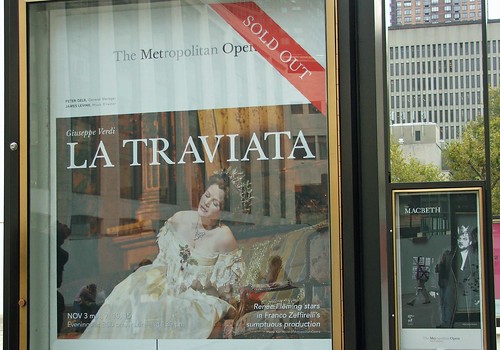
On Saturday afternoon, 3 November, I saw this seasons opening performance of La Traviata at the Met.

The production, which is now almost ten years old, was created and designed by Franco Zeffirelli. It is, of course, very elaborate. All the scenes but one are performed in sets which are very detailed architectural reproductions. The country house in Act 2 is straight out of Vogue Living. This and Violetta’s house in Acts 1 and 3 are built in rectangular boxes which occupy only half of the height of the stage; hence a wide aspect ratio. In Act 3, Violetta is first found in her bedroom, which during the course of the act is raised (out of sight) on a lift to reveal the rooms seen in act 1. As is usual the furniture is draped and the gaiety of the first act long gone. Violetta comes downstairs in the course of this change and the final part of the opera is seen in these living rooms.

The exception is Act 2, scene2 which is performed in a set which uses the whole height of the stage, beginning with light drapes which lift to reveal the room in which the party takes place. I suspect that the whole stage was needed at this point to accommodate the dancers who appear in this scene, but the change does create a discontinuity in the way the production runs.

The elaborate staging worked well; but I wonder if all of it was necessary. The movement between rooms in the last act was achieved smoothly and was not a real distraction. La Traviata does require realistic staging but in the end result the success of a production will depend far more on the quality of the singing and orchestral playing than very elaborate staging.

Renee Fleming, one of the great sopranos of today was Violetta and her performance was excellent. I was reminded of her wide ranging skills as an artist by her singing of Blanche in the San Francisco recording of Andre Previn’s A Streetcar Named Desire.

Earlier this year we saw Opera Australia’s production of La Traviata with the Russian soprano Elvira Fatykhova as Violetta. Renee Fleming’s portrayal was more evenly sung: Ms. Fatykhova adopted a new and weaker voice when singing the dying Violetta of Act 3; others have done the same, but this performance showed that singing this part of the opera in a fuller more natural voice was just as effective.

Alfredo was sung by Mathew Polenzani was also excellent. While we may wait for a really thrilling tenor, I have not heard a bad or irritating one at the Met so far.

I have never given much thought to Germont senior and tended to dismiss him as the most boring character in the whole of opera. However,I have been listening to some podcasts from the Lyric Opera of Chicago in which Mark Delavan who sang Germont senior there October 2007 discusses the dialog between Violetta and Germont senior in Act 2. In the first discussion he spoke as if the Germont was not only shocked by the character and integrity of Violetta as it emerges during their conversation but also developed his argument to her by stages, discarding ideas which did not seem to work as he went along. In the second podcast he identified changes in the character first, from the point where he called Violetta by her first name and seconldly from “ Piangi piangi ….”

In this production, Germont was Dwayne Croft. He was stern and unrelenting at his entrance, and his manner did soften as the Act progressed but I wonder if a great deal subtlety is really available in the portrayal of this unsympathetic man. One thing I picked up from the Chicago discussion was the similarity in character between father and son. They both wallow in self indulgent remorse and I think the music reflects this. Certainly the portrayal of father and son here gave full effect to this common trait.

Saturday, 10 November 2007

Agrippina

agr2
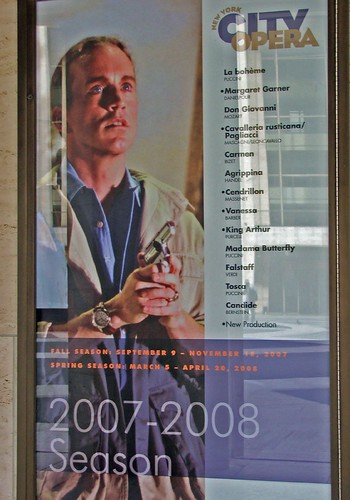
David Walker as Ottone with automatic weapon and reflections.


I had almost given up on New York City Opera. The performances I had seen there were interesting but I always found something to complain to myself about, rightly or wrongly.

On 2 November, I saw Handel’s Agrippina which is a co production with Glimmerglass Opera. As well as my City Opera phobia I had concerns that Agrippina was an early Handel opera, first performed in Venice in about 1710. Early Handel is fine by me: I should look into it further, but it seems that at that point in his career Handel was less bound by the traditions of opera seria or maybe those traditions hadn’t fully developed. The music is fresh and lively and although Handel later recycled some of it, nothing was familiar to me. The orchestra included recorders, lute and baroque guitar and theorbos but was otherwise made up of modern instruments. There must have been some amplification of these instruments; and I understand that amplification is common in the State Theatre in any event to combat the bad acoustics, but I didn’t notice it. Last year I heard Semele in the State theatre and from where I was then seated in the back of the main auditorium I heard some peculiar effects which made the sound jumbled at times.

There is a delightful flute solo in the second act, and when I looked down, there was the conductor, Ransom Wilson, on his podium playing it. This was a first for me. Afterwards, I thought that I had been suffering from some kind of delusion but search on the net showed that Mr. Wilson is a well established flutist as well as a conductor.

The production was lively, funny, and well sung. The opera itself takes an ironic view of the historical events it portrays and this view is developed by the production. The sets are mobile structures which are moved to form the various rooms and spaces where the action takes place. They are decorated with bits and pieces of Ancient Rome to give the correct sense of place. There are also some simple abstract shapes in strong colours which are used from time to time to provide visual contrasts.

The singers are in modern dress, and there are firearms. Both were keys to the way the production worked and were not intrusive. The dress and firearms in the Met’s production of Macbeth seemed unnecessary, as I have said. I wonder if there is a rule about this. There is always the risk that impressions like this depend more on how you are feeling at the time than any real fault in a production.

As an example, at the time of the events portrayed, Nero, Agrippina’s son is an adolescent. He is sung by mezzo soprano Jennifa Rivera who manages to include aspects of normal adolescent behaviour with strong hints of the pathological character which the historical Nero became. She is helped by the modern wardrobe which establishes that Nero has a narcissistic interest in fashionable dress, and by the firearms. Early in the first Act after doting on his mother Agrippina, he is left alone with a revolver, and plays a game of Russian roulette which ends with a maniacal laugh when he survives.

Arrippina , whose machinations would put any modern politician to shame, was given a delightfully ironic and wonderfully sung portrayal by Nelly Miricioiu. Ottone, the only character innocent of guile, was countertenor David Walker, to be heard again soon as Holofernes in Juditha Triumphans Pinchgut Opera's 2007 production.

The minor character Narciso was David Korn, described as a male soprano. I find that this description is used for a counter tenor who sings in the female soprano range; the more common range for counter tenors being equivalent to mezzo soprano or contralto.
There is an article about the male soprano or sopranist here: http://en.wikipedia.org/wiki/Male_soprano
Knowing nothing of the technicalities of the subject I can’t comment on its accuracy.