Friday, 26 February 2010

A MIDSUMMER NIGHTS DREAM Opera Australia 2010

msnd
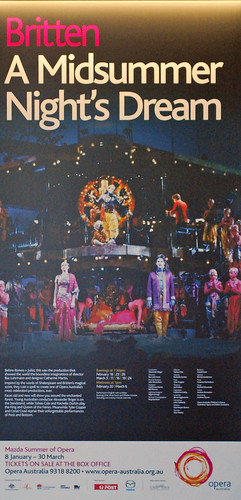
Opera Australia has revived Baz Luhrmann's 1993 production of Britten's AMidsummer Night's Dream. Tempus fugit. It's hard to imagine that I first saw this show almost 20 years ago.
It was absolutely magical. Magic has a lot to do with first impressions as Shakespeare's play itself shows, so it's not surprising that the sense of wonder created by the first performance fades a little the more you see it, but it remains an excellent production. I am interested to explore why this is so: the removal of the action from ancient Athens to a bandstand in an India ruled by George V, is a substantial change, but it hardly seems to matter at all.

When W.H.Auden came to The Merry Wives of Windsor in his lecture series on Shakespeare's plays given in New York in 1947 he said:

"The Merry Wives of Windsor is a very dull play indeed. We can be grateful for it having been written, because it provided the occasion for Verdi's Falstaff, a very great operatic masterpiece. Mr. Page, Shallow, Slender, and The Host disappear. I have nothing to say about Shakespeare's play, so let's hear Verdi."

Britten's Dream is also a very great operatic masterpiece, but we can't dismiss its source so abruptly. Britten and Peter Pears collaborated on the libretto. They edited the text of the play so as to reduce it by about half but they made very few alterations to the words.

However, their excisions alter the balance of the play. Act I Scene 1 set in the Palace of Theseus almost entirely deleted and Scene 2 is deferred, so that the opera begins with the chords which are so evocative of the deepening night, and the entrance of the fairies. The fairies are a new character: they replace a single fairy who doesn't have much to say and appropriate many of Puck's lines as well. Britten had a precedent. Verdi did the same thing when he transformed the witches in Macbeth into a chorus.

I haven't counted the lines but I suspect that most of what Oberon, Titania, Puck and now the fairies have to say is retained from the play. But it's not only this, and their placement at the beginning of the opera which gives them much more prominence; Britten has given much of the most memorable music to Oberon from
 "I know a bank where the wild thyme blows... ", and
"Be it on lion or bear or wolf or bull ..." to the wonderful concluding music which sets
 "Now, until the break of day...".
It was a masterstroke to give this music to a countertenor.
In his lectures, Auden says that in A Midsummer Night's Dream, Shakespeare: "..mythalogically anthropomorphises nature, making nature like man.." so that "..mythological characters are used to describe certain universal experiences which we cannot control." In other words, the fairy characters animate nature and personify the psychological forces which influence the behaviour of the lovers. By giving this aspect of the play greater prominence, Britten has shifted our focus from the human drama to the mysterious forces at work in the wood.

I don't know anything about Hindu religion, but it seems to me that by giving the fairy characters an Indian persona Baz Luhrmann has found in a polytheist, or perhaps animist, religion a good analogy with Britten's version of the play. It fits the music perfectly even if we don't take into account the way in which much of the movement has been carefully choreographed to fit the score. The whole concept enhances the work and does not, as happens too often, attempt to substitute some half thought out idea of the director for the genius of the piece being performed.

There are a couple of references to India in Shakespeare's text which were probably the jumping off point for the Indian setting, but in themselves these would have been insufficient basis for it. References to Athens are retained and are superficially inappropriate, but because the idea as a whole is in harmony with the way the opera works, although they intrude a little, they don't grate.

The set, which places the orchestra in the bandstand on the stage and extends the acting area at the front is also helpful. It replicates the thrust stage, copying the theatres of Shakespeare's time, which has returned to use in the modern theatre.

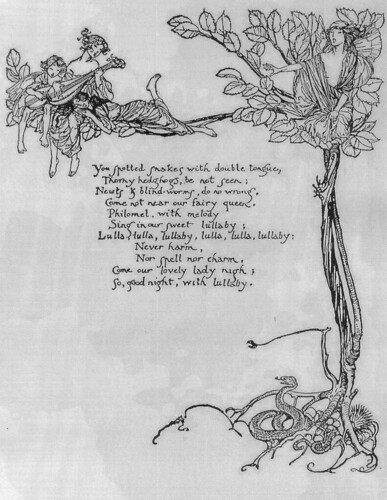
One reason the production works so well for us is that it is modern in this sense. It's modernity also reflects Britten. His mysterious and sensual score is very different from Mendelssohn's familiar incidental music which sounds trivial by comparison. Mendelssohn's music was, it seems to me, perfectly in accord with the way in which the nineteenth century saw A Midsummer Night's Dream. Arthur Rackham and W. Heath Robinson both produced illustrated editions of the play. They retain classical antiquity as the setting, but the characters are pure fantasy.
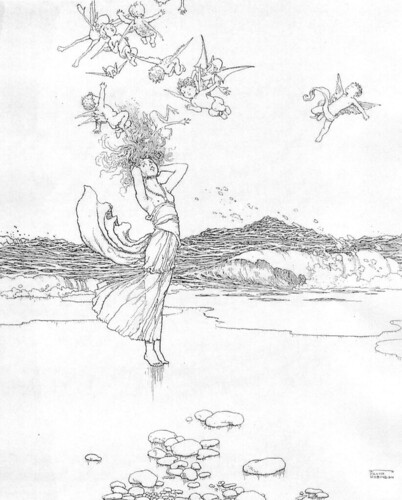
Heath Robinson
W. Heath Robinson

Rackham
Arthur Rackham

The artists might have seen the play as a delicate and finely worked out farce, amusing but lacking substance. Similarly, in the nineteenth century theatre, Shakespeare's plays were produced with emphasis on costume and pageantry, with, I suspect, a loss of some human interaction and urgency, even in comedy. Although Britten has altered Shakespeare's emphasis, the dark and mysterious forces of nature were always there.

As the opening scene in the palace of Theseus is excised, the relationships between Demetrius and Helena and Lysander and Hermia and their position in relation to Theseus are not as clear as they might be, and the production makes an attempt to overcome this problem by staging some mime between these characters before the music begins. As the scene is brief and without words, it cannot reproduce pages of missing text, but it is another example of the way in the production is faithful to both the opera and the play.

There is usually much more in a production than can be taken in, unless you see the performance a number of times and pay close attention. And when a show is revived more than once, the director may well make changes, which can play with memories of earlier times. For example, I don't remember seeing the removal of Oberon's finger nails ( or are they fingers), before. When Oberon first appears his hands are more like claws, with long spiky nails. Later on, when his mood has improved, and he is about to be re united with Titania these are removed leaving him with hands of normal proportions. This represents the substantial change which occurs once Oberon has his own way and takes possession of the changeling boy from Titania.

What are we to think of Oberon when we first see him in vengeful mood ? I would have thought he was more scheming and mischievous than malicious, but I found another opinion in Kobbe's opera book. The article by Lord Harewood on the opera quotes David Drew, writing of the first performance in the New Statesman:

"Whether intended or not Britten's Oberon is a more grimly effective horror than the Peter Quint who called from the Tower and had no Puck to help him." Peter Quint, who appears in Britten's Turn of the Screw is a wholly malevolent character who hardly needs a Puck to help ( though he has help of a different order from Miss Jessel.) Apart from Britten's use of the celesta in the accompaniment of both characters, I find nothing in common between them. The music creates an atmosphere of mystery, even unease, but it is hard to find evil personified in the remarkable settings of the verse which I have mentioned.

Even assuming Oberon's falling out with Titania is malicious, his intervention in the lovers' affairs is at worst mischievous, even though it goes wrong at first. Then, as the fingernail removal shows, he becomes quite a benign figure, and his singing of "Now until the break of day", is a dramatic and musical resolution of the whole piece.
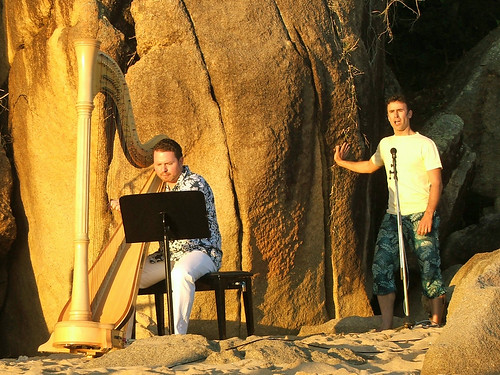
In the current OA production Oberon is effectively portrayed by Tobias Cole, who I was lucky enough to hear a couple of years ago singing Orpheus on Orpheus Island as part of the Australian Festival of Chamber Music.
Countertenor
Tobias Cole and Marshall McGuire on Orpheus Island (July 2006)


He also sang the title role in Handel's Julius Caesar to great effect.

The role of Titiania suited Rachelle Durkin's voice perfectly. The cast was uniformly excellent. The overall quality of the singing at Opera Australia seems to get better year by year.

When I first saw this production long ago in 1993, it seemed that the appearance of the rustics in military uniform was an affectionate tribute to the television comedy It Ain't Half Hot Mum. That show is so lost in the past that it took me a while to remember the probable reference to it; and when I checked I found that its production run ended about ten years before this Dream was first seen. I think most people still remembered it then however.

There is an excellent summary of the musical techniques used in the opera in Michael Kennedy's book on Britten in the Master Musicians series. He describes the music for the play performed by the rustics as:" (an) extended, affectionate and musically very witty commentary on the conventions of the Donizetti type of Italian opera.." and suggests that:

"Provided the singers do not overplay it, it is a scene that yields fresh delights at each renewal." Those delights are denied us here, as the play is performed as broad farce. It's amusing, but it would be interesting to see a performance in which the music did more of the work.

After the play, the lovers gather for a group photograph taken by a bellows camera with a magnesium flash. This is a fairly early example of this cliché in recent opera productions around the world.
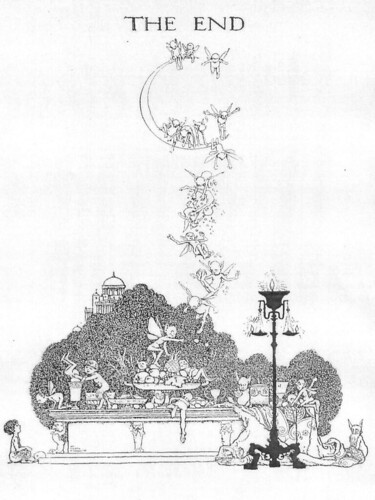
The end

Friday, 12 February 2010

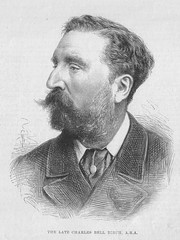
Charles Bell Birch

The Late Charles Bell Birch A.R.A
from The London Illustrated News, 21 October 1893

This all began in Townsville in August. I was there for the Australian Festival of Chamber Music and after hearing a concert which included various pieces by Argentinean composer Astor Piazzolla it was only to be expected that I would find a message from Argentina on my laptop, and there it was:

Hi !

I was wondering if you have more pictures of this:

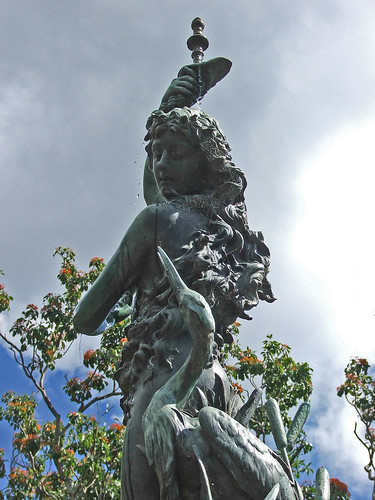
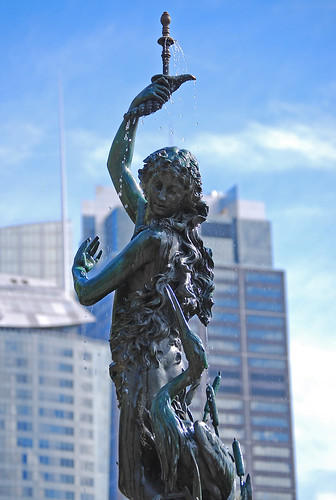
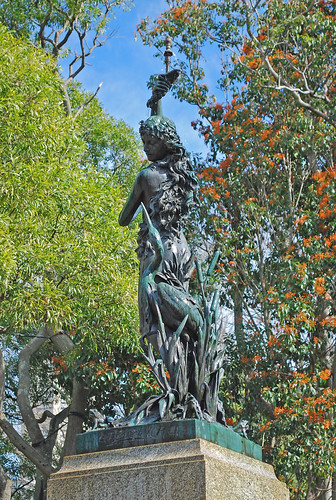
"Art Nouveau fountain by C.B. Birch surmounted with a bronze statue of a young girl with a heron and reeds and frogs at the base"

That´s an awesome fountain and it would be great if you could upload more images.

Thank you!

Esteban

Esteban was referring to this photo which I had taken in the Sydney Botanical Gardens the year before:

Fountain

The description attached to the photo came from The Royal Botanical Gardens website.

I found that Esteban was from Córdoba, Argentina; and provoked by his interest decided to re visit the statue on my return to Sydney.

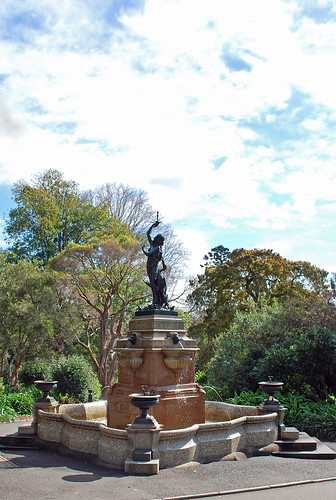
The fountain, said to be one of the last remaining drinking fountains in Sydney, was erected as a memorial to the businessman and politician Lewis Wolfe Levy, who was born in London in 1815 and came to Australia in 1840. He had an active and successful business career, was twice elected to the Legislative Assembly and was later appointed to the Legislative Council. He died in 1885: according to the Australian Dictionary of Biography, "Although self-made, plain spoken and occasionally short tempered, he was widely respected and sincerely mourned".

Red Granite base

There is a more detailed description of the fountain in the excellent Poetry of Place by Edwin Wilson, which catalogues and describes all of the statues in the gardens and the Domain. The bronze statue of a water nymph with a heron and surrounding reeds and frogs is the work of Charles Bell Birch, the English sculptor who is discussed here. The statue was erected in 1889 having been cast at a foundry at Thames Ditton in England.

City background

Frog


I don't think "Art Nouveau" is a misdescription of the style: it looks that way to me, but it would make Birch a very early exponent of Nouveau. The Maison de l'Art Nouveau in Paris opened in 1895, and the movement itself is given the dates 1890 - 1905.  The Arts and Crafts movement in England is often cited as a source of Art Nouveau and Birch would surely have been exposed to the movement, but his other work and the little I have discovered about him do not suggest a relationship.

I have found that Birch is a neglected artist in the neglected genre of Victorian sculpture. From one point of view the lack of interest in this field is hard to understand. The cities of Britain, and the old Empire, including Australia, are decorated with statues and sculptures from the nineteenth century made by artists in whom little interest remains. The works are seen by millions of people every day but the artists are unknown.

There are a few references to Charles Birch in more general books and on the web, but no biography I can locate and no article in wikipedia as yet. There is, however, an article in the Dictionary of National Biography.

He was born in Brixton in 1832, the son of Jonathan Birch, an author with the unrealised ambition of becoming a sculptor himself. While still a youth, Charles Birch travelled to Germany where he studied at Kurfürstliche Akademie der Künste and with the German sculptors Ludwig Wichmann and Christian Rauch. It is suggested that: " his style was more or less set by his training in Berlin, with what has been described as 'a naturalistic veneer upon a classical foundation'." I would need to know much more about the German style of the period to assess this view, but the works which I have seen don't seem to embody any one particular style.

Birch returned to Britain in 1852, and entered the Royal Academy Schools. Then in 1859 he became principal assistant to John Henry Foley and remained in that position until Foley's death in 1874.

He had his first great success in 1864 when the Art Union of London awarded him a premium (meaning, I think, a prize for acquisition) of 600 pounds for "A Wood Nymph", which was shown in Vienna, Philadelphia and Paris. There is an image of this work here: although a nymph, this one seems quite different from the water nymph seen in the Levy fountain.

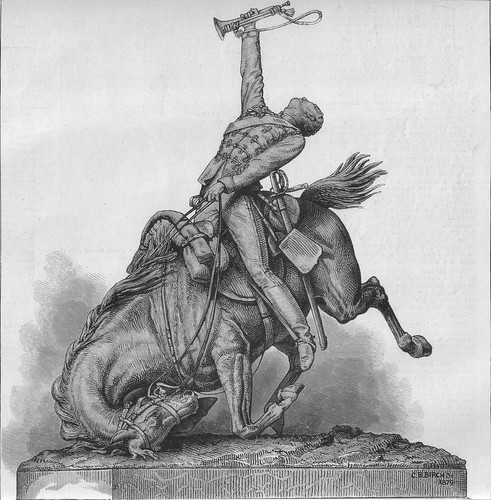
Birch sculpted " realistic and vigorous " or Boy's Own - depending on your approach- military sculptures. He made The Last Call in 1879:

The Last Call
from The London Illustrated News, 21 October 1893


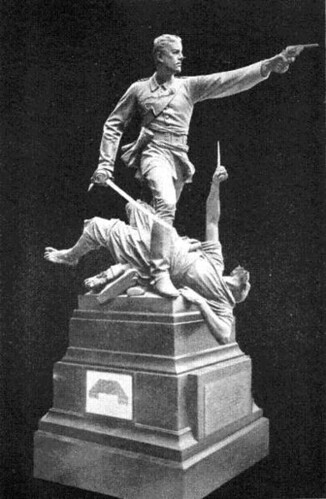
and Walter Hamilton VC "striding over an Afghan threatening him with a knife " in bronze-painted plaster in 1880.

Walter_Richard_Pollock_Hamilton

These works have a recognisable style of their own, which looks to me quite different from either nymph.

The success of Hamilton VC resulted in Birch being elected an associate of the Royal Academy in April of 1880.

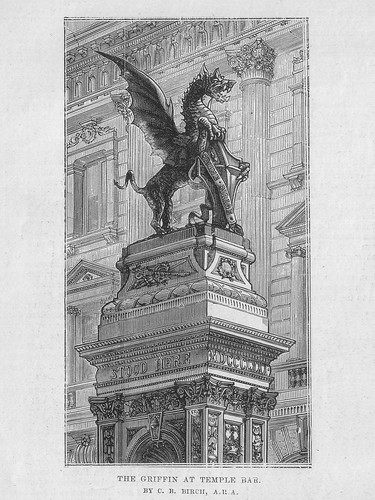
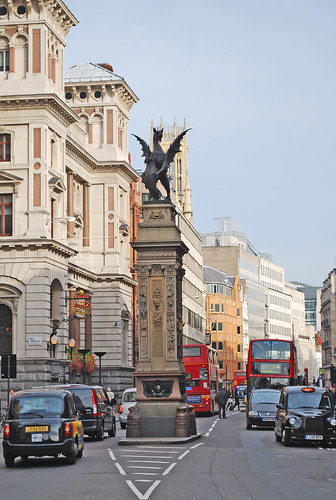
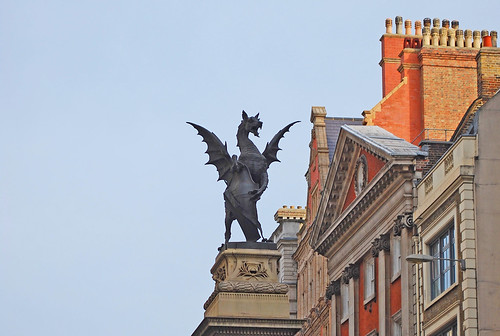
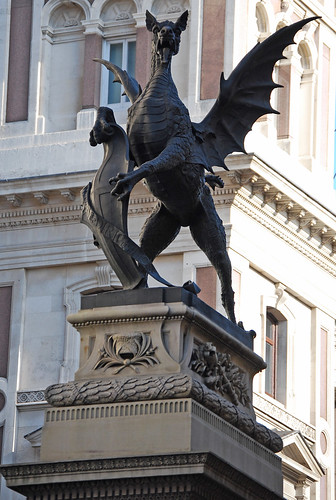
Birch was at the height of his fame in that year, in which, what must be his most often seen work, the griffin on the Temple Bar Memorial in London was erected.
The Griffin at Temple Bar
from The London Illustrated News, 21 October 1893

 The Temple Bar Memorial which replaced the old Temple Bar was a controversial project at the time. The Temple Bar itself was removed because it had become an obstruction to traffic, but the new memorial was seen as another, if lesser, obstruction in itself. The DNB calls Birch's sculpture " the unfortunate bronze griffin", but I would like to think that at least some of the criticism of it which is reported confuses opposition to the structure itself with a dislike of the griffin.

Temple Bar Memorial


Phillip Ward Jackson in Public Sculpture of The City of London notes that when the memorial was opened by Prince Leopold in September 1880, with Birch in attendance, The Times reported that "...a crowd stationed within the new Law Courts groaned throughout the brief ceremony".

City Dragon

Ward Jackson also records that a critic in the Builder commended the "vigour and power" of the griffin while the Architect said that " the artistic courage and strength of will manifested in this magnificently ungainly object are prodigious ". There was no unanimity however: Building News stated:

"...Let the First Commissioner of Works seize the opportunity and draw (Queen Victoria's) attention to that wretched object the Griffin. If Her Majesty does not counsel its immediate removal, she has lost the unerring perception of truth and beauty which have distinguished her reign".

And Darke's The Monument Guide to England reports that the griffin has been likened to " an animated corkscrew ".

Griffin

But it has guarded the entrance to the city for almost 130 years.

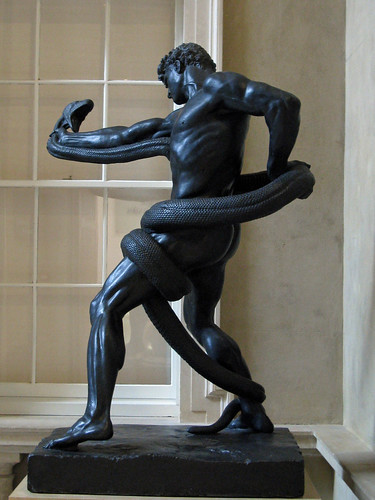
Charles Birch is often said to be an exponent of The New Sculpture, understood to be a movement towards greater naturalism in later Victorian sculpture. The critic Edmond Gosse used the term in articles written in the 1890's. Frederick Leighton's Athlete Wrestling with a Python of 1877 is seen as the key work in the movement.

Python


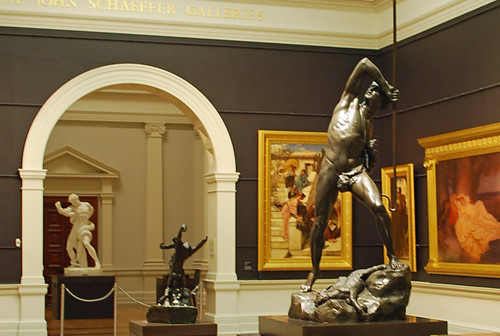
Two copies of this work are presently displayed in the Art Gallery of New South Wales.

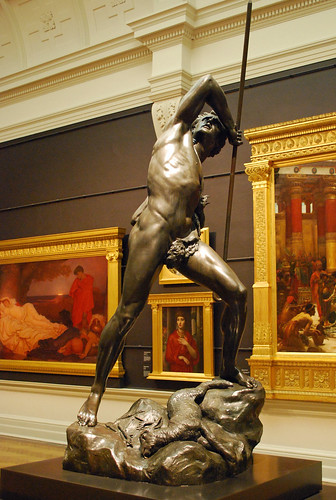
Not far from them is Charles Birch's Retaliation made in 1888 and exhibited at the Sydney International Exhibition in 1879 where it won the award of "First Degree of Merit Special".

Retribution

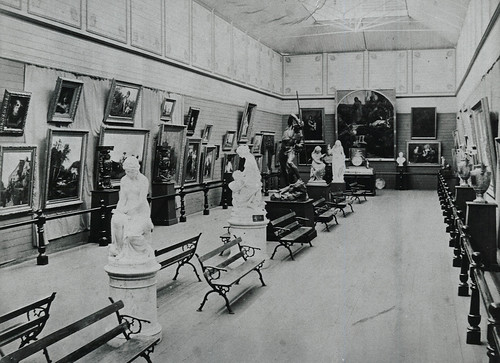
It can be seen in this photograph from the Art Galley archives taken in 1881:

Art Gallery 1881

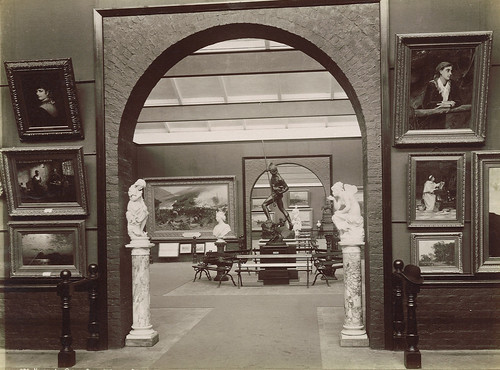
And again in 1885 in the new gallery:

Art Gallery 1885

It didn't remain in fashion however and in 1958, it was sold to the Botanical Gardens, where it was placed in the pathway through the Palm Grove. It was not undisturbed: in 1961 a truck collided with the statue requiring repairs to its marble base. Then in about 1977, the Art Gallery had second thoughts and arranged to take it back as a swap for The Satyr by Frank Lynch now in the Gardens near the Opera House gates.

Retribution

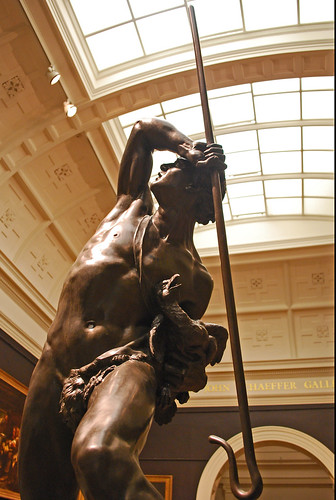
It is quite likely that Retaliation was influenced by the Athlete Wrestling but as it was completed only a year later, it would not be possible to say this with certainty without more information. It is a work of high drama, the naked shepherd, (note the crook), appears to have wrung the neck of the bird of prey responsible for the death of the lamb lying at his feet.

Retribution

Perhaps it was the success of this work which led to Birch's commission to make the Levy fountain. But if he drew the inspiration for Retribution from Leighton, what was the source of the bronze statue of a young girl with a heron and reeds and frogs at the base on the Levy Memorial Fountain ?

Diana

Birch died in 1893.  A full page tribute was published in The London Illustrated News including the images reproduced above.  The article was as follows:

THE LATE MR. C. B. BIRCH, A.R.A.

The death of Mr. Charles Bell Birch, the well-known sculptor, removes an interesting and prominent figure from the world of art. Mr. Birch died on Monday Oct. 1, at the age of sixty-one, having been born in Brixton in 1832. For many years he was a student of the Berlin Royal Academy.

It was in Berlin, in 1852, that he produced his first important work, a bust of the late Earl of Westmorland, at that time Ambassador to Prussia. On his return to England Mr. Birch entered the studio of the late Mr. Foley R.A., where for ten years he acted as principal assistant ; in 1864 he was the successful competitor at an Art Union competition, where his subject, " The Wood Nymph," carried -off the prize of £600. For many years Mr. Birch was acting as a wood-engraver, and much of his work may be seen in the pages of this Journal, as well as in other publications. His equestrian group, " The Last Call," exhibited at the Royal Academy, which is here reproduced, was the proximate cause of his election to the Associateship of the Royal Academy in 1880. It is, perhaps, by the work which we reproduce here, the famous Griffin, which looks down upon us from the site of Temple Bar, that Mr. Birch is most widely known to the public, although a mere list of his statues -would make a formidable catalogue. At a later period he devoted himself to producing statues for public buildings in this country and the colonies, and many of these were marked by considerable vigour and massiveness. In his more imaginative work amongst which must be included the silver statuettes and race cups for which he received frequent commissions, he allowed his fancy fuller play, but as a rule his work suffered from the constant pressure under which it was produced.

Towards the end of his life, Birch made a statue of Queen Victoria, of which a number of casts were made. The first was made for Udaipur in India and was erected there in 1889. After Birch's death a cast of it was erected on the northern approach to Blackfriars Bridge in London. It was unveiled by the Queen's cousin, the Duke of Cambridge, on 21 July 1896.  The duke regretted the sculptor had not survived to see his work erected there.
I looked for it  in November 2009, but did not see it. I assumed it had been moved to a place of safety during the renovation works being done in and around Blackfriars Station.


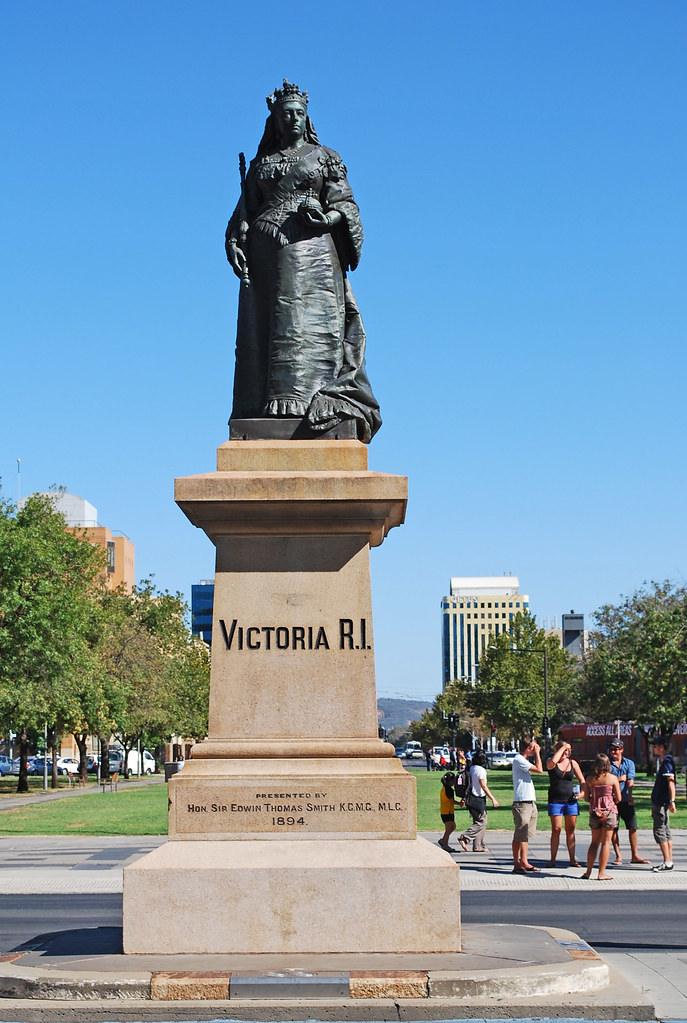
Another example was given to the City of Adelaide by Sir Edwin Smith MLC and erected there in 1894. It stands in Victoria Square where I saw it in March 2010.

Queen Victoria

Queen Victoria


*************
Posted 12 February 2010

Amended 23 February 2010 to add illustrations and quotation from The London Illustrated News

Amended 10 March 2010 to add Queen Victoria in Adelaide

Monday, 11 January 2010

TOSCA 2010

Angel

Opera Australia has opened its 2010 season with a new production of Puccini's Tosca. There was some fine singing from a wholly committed cast, but it's a production I hope never to see again. American soprano Tekesha Meske Kizart gave strong performance as Tosca; specially, as in her visse d'arte, when unimpeded by the director's concept.


I first saw Tosca in 1953, and thought I might qualify for some kind of record until, while listening to the opening night of the Met's 2009 Tosca online, I learned that Licia Albanese who sang the role at the Met in 1950 was in the audience. In any event, I have known Tosca for more than half the life of the work, and heard it many times.

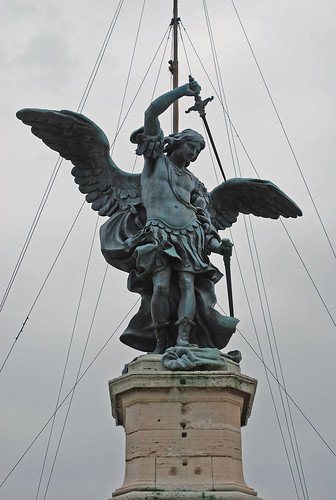
It's true that Puccini wrote memorable tunes, but there is a lot more to his music. He often creates not only atmosphere and mood, but also a sense of place. For example, in Il Trittico: contrast the music opening Il Tabarro depicting the barges on the Seine complete with fog horns, and the entirely different music for the convent garden in Soeur Angelica. The music of Tosca is very much tied to the historical settings: the Te Deum in Sant'Andrea della Valle and the sound of the church bells at the opening of Act 3. I discovered from an article in the OA program that Puccini went to the top of the Castel St. Angelo to hear the bells and ensure he had their pitch right.

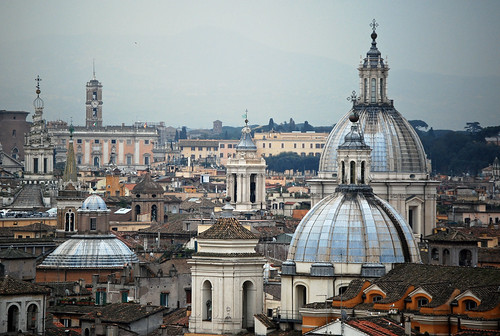
Rome

In April last year I stood at the ramparts of the Castel St. Angelo, looking out over Rome when church bells began to ring. It wasn't dawn, but it was extraordinarily moving to be reminded of the music of Tosca in the place where Act 3 is set.

The new production by Christopher Alden for Opera Australia places the story in a single room, and moves the story to present day Italy. The intention is to heighten the immediacy of the drama, but it is a bold step to excise so completely the locations movingly represented in the music. Nothing a particular production does can destroy a work, which remains intact to be performed again in another style; classic plays are cut and altered often to excellent effect, throwing new light on the familiar. Notwithstanding the advent of directors' opera, the continuity provided by the music makes it impossible to cut and amend the text in the way which has become commonplace for Shakespeare and other classic plays. Some works appear in different versions of course and some can be and are cut, but the music is a constraint. I think that in Tosca, the music is more than a constraint on adaption; its suggestions of place, character and atmosphere are the reason the opera continues to be performed over 100 years since it was composed. The play by Sardou, on which Tosca is based, is not in demand.

Christopher Alden's production, though new to Australia, was first performed by Opera North in 2002, and has been revived there since. English critics liked it; which makes an interesting comparison with the reception given by both critics and the opening night audience to the much less radical new production by Luc Bondy for the Met in New York.

Writing in The Independent in 2002, Anthony Arblaster, who admits he thinks Tosca is a "nasty melodrama", said:

Alden sets the opera in contemporary Italy, and treats it as a lesson in the habitual ruthlessness and casual brutality of modern state power. This involves taking a few liberties with the narrative (sic), but the gain is that the story is dragged out of the comfortable never-never land of Late Romanticism and placed in our time, when torture and murder are the stock- in-trade of many states. The results are suitably shocking.

And Richard Morrison, writing about the 2008 revival in The Times enjoyed a compelling night in the theatre.

while recognising that:

...the American takes brazen liberties with the time, place and plot of Puccini’s 1900 thriller. And sometimes he seems perversely determined to subvert the music’s power as well.

Writing in The Guardian, Mr. Alden himself says:

 The posters for Berlusconi's Forza Italia party that line the walls of the dingy church basement in which this Tosca is set rob the audience of the comforting thought that Scarpia's repressive despotism has vanished from our world.

These days many opera directors are anxious to rob us of these kinds of comforting thoughts: but who thinks them? I have never met anybody under the delusion that repressive despotism has vanished; anyone suffering from it would need to live in comfortable isolation from all the media, even Berlusconi's media. At the risk of turning moraliser myself, it is not accurate or sensible to equate the Berlusconi government and Scarpia's despotism.

The single purpose set is a large room, apparently attached to a church though with some very large klieg lights hanging from the ceiling. Though not a usual ecclesiastical fitting, they are useful if the room is wanted for an interrogation. There is a confessional box in the back and glassed in alcove with a television set, probably tuned to a Berlusconi channel, in the front.

Though I was puzzled about how the Te Deum would be performed in such a utilitarian space, things were promising to start with. The sacristan's conversion into a surly janitor was a nice change from the familiar comic turn, and Tosca's display of jealousy and suspicion was particularly effective. Then a strange thing happened, the escaped prisoner, Angelloti, emerged from the confessional which served as the private chapel where he hides, and sat in a chair to the side of the stage. Strange because the score includes music to show his stress and anxiety as he leaves the chapel, but this music comes after Tosca has left.

Tosca does not see him as she leaves ( understandably in one sense, as in the opera as written he is not there ) which makes no dramatic sense. Later, in Act 2, Scarpia's henchmen Spoletta and Sciarrone are left in the back of the room oblivious to the seduction and murder taking place a few feet away. This kind of thing is a distraction from the drama, unless you are intrigued by working on something akin to a cryptic crossword puzzle while watching the performance. It must be a STATEMENT of some kind, but what ? It could just be the usual post modernist device of leaving actors sitting about the stage so that we don't forget we are in a theatre; but my best guess about this one is that it somehow stands for a proposition resembling evil is everywhere but we do not see it even when it's before our very eyes. Bravo.

Scarpia's entrance in Act I of Tosca is, I think, the most spine chilling moment in all of opera. Puccini breaks into the games of the choir boys and sacristan with an ominous statement of Scarpia's theme. Here, the possibilities of this moment are lost, as Scarpia has already wandered into the room by the time this music is reached.

I think that the portrayal of Scarpia in this production is wrong. It is true that Scarpia, as written, is a sterotypical villain out of melodrama; but this has not prevented great performances of the role which provide alarming insights into the nature of lust and despotic power. This Scarpia escapes one set of stereotypes and enters another: he is seen as a pathological figure whose lust is accompanied by a frenzied religious guilt.

This cannot be the Scarpia who sings:

I lust, and what I lust for I pursue,
I take my fill and throw it away
Then turn to a new attraction.
God created an abundance of beauties and wines
I want to savour all that I can of God's creation !

This passage and its music do not stand with the characterisation imposed on Scarpia, and as John Wegner performed it with great force and effect, he seemed to step out of himself and into the shoes of the real Scarpia.

The enactment of the Te Deum which ends Act 1, is associated with the distribution of lotto tickets from the sacristan's alcove. Why, I cannot imagine.

Act 2 and 3 are run together. The introduction to Act 3 is sung by the Marchesse Attavanti, rather than the shepherd boy as specified. The Marchesse had taken up a position on top of the confessional box where she reacts to the action with various gestures, assumes a foetal position and so on. The only consolation for this was the opportunity to hear Sian Pendry, who has a lovely voice, even when singing music which only emphasised the limits of what was going on.

Act 3 would have been wholly inexplicable, as almost all of the narrative is replaced by one which has no relation to the libretto or the music, had I not found Mr. Alden's Guardian article, in which he explains:

And when it comes to the last act, the production rejects the naturalistic verismo ethic as the best way to capture its bleak horror; instead, it is played out as a fantasy unfolding in the broken Tosca's demented mind. By the final curtain, the basement is littered with the corpses and the atmosphere hovers somewhere between Beckett and Tarantino.

Consistently with this approach, Tosca spends the whole of the Act cowering at the side of the confessional box. This is not a performance of Tosca at all. It is an invention riding on the coat tails of Puccini's magnificent score.


The AO production replaces one by John Copley which has had many revivals. It was a production which owed a great deal to Franco Zeffirelli's Tosca at the Met which was replaced by the new Luc Bondy production I have mentioned. Unlike the Zeffirelli and Copely productions, the new Met Tosca doesn't attempt to reproduce the historical locations of each act, but it does retain them. The church, palace and ramparts are replaced by nondescript sets and the costumes do not reproduce the dress of the historical period - or any particular period. The new Tosca was met by uproar on opening night and great objection from traditionalists - and Mr. Zeffirelli.

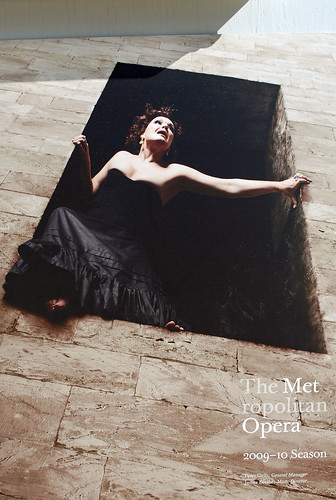
Tosca

When I saw it in October, I was unable to understand the commotion. It was true that visually the historical locales were lost; but what was seen did not depart in any radical way from the story or the music. There was a gripping performance of the title role by the wonderful Katia Matilla. It is now available for everyone to see on the excellent Met Player - though the video production seems overly dark, and a lot of the movement in Act 3 is much harder to see than it was in the theatre.

It seemed to me that, although something was lost by making the locations anonymous, the production did gain a feeling of contemporary relevance of the kind Mr. Alden was attempting to achieve. I wondered if a few subtle changes to the libretto could place the work in, say, Franco's Spain to good effect.

But it was not only the first night crowd wrenched from their familiar pretty scenery that objected.

Alex Ross wrote in the New Yorker that Bondy:

...delivered an uneven, muddled, weirdly dull production that interferes fatally with the working of Puccini’s perfect contraption.

And in The New York Times, Anthony Tommasini:

Mr. Bondy probably wanted to rid his “Tosca” of stock clichés, yet his heavy-handed ideas are just as hackneyed.

When sensitive and experienced critics express views like these, it's worth pausing to consider the intricate relationship between words, music and dramatic narrative that give opera its place in our imagination. There cannot be innovation without mistakes, but the OA Tosca, for all its superficial excitement and excellent singing, goes too far in the wrong direction.

Monday, 4 January 2010

Burj Dubai

Today is the official opening of Burj Dubai, the world's tallest building. There seems no doubt that it is the tallest; and its actual height will be revealed at the opening. The Times says it is the first time the Arab world has claimed the title of the world’s tallest building since 1311, when Lincoln Cathedral exceeded the height of the Great Pyramid of Giza. It also reports that it cost a billion pounds, somewhat less than the ABC news claim that the tower and surrounding development has cost about $22 billion to build.


In March 2009, when I spent a day in Dubai, the building was, I think, structurally complete and dominated the city skyline.

Dubai skyline

The architecture of Dubai is entirely modern; but the evocative sound of the call to prayer from any number of mosques as the night fell told that we were in a different world.

Dubai at dusk

Saturday, 2 January 2010

The thistle under the plaid

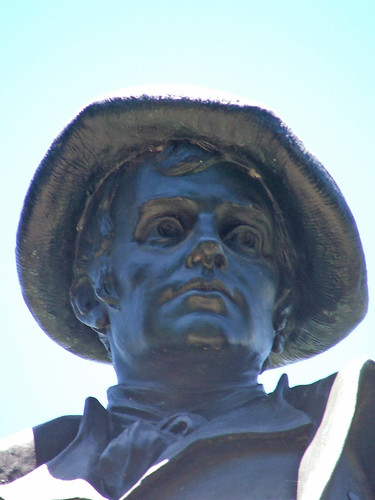
Head

I have written here previously about the statue of Robert Burns by Frederick Pomeroy in the Sydney Domain. Now, thanks to the wonders of the Internet I have discovered some more of its history. A short time after the statue was erected, Edward Goodwillie published his book The World's Memorials of Robert Burns in Detroit, Michigan. Lacking the Internet he gathered information about the statues and memorials from correspondents all over the world. His information about the statue in Sydney came from Mr. James Muir, a much-traveled, well-read Scot, one of the greatest students of Burns in Australia, if not in the world.

The text of his book and a pdf file version are available.

SYDNEY, NEW SOUTH WALES. Sydney, the oldest city in Australia and the Capital of what is now the State of New South Wales, has an elaborate memorial to Burns in its picturesque "Domain." The desire amongst the leal-hearted Scots of this beautiful city of hills and harbors to erect a memorial of some kind to the Bard of Scotia, existed for many years as an aspiration, and slowly but surely gathered strength towards practical realization. A few enthusiastic spirits banded themselves together in the early nineties, pledging each other to eat haggis on the 25th of January and to collect funds for a Burns statue during the remainder of the year. They designated themselves the "Burns Monument Committee," and for some years went joyously on their way. Finally, however, they determined to take more aggressive steps, and in 1898 they appealed to the Highland Society of New South Wales to take up the work. The latter cordially assented and accepted the collected funds, amounting to some fifty-five pounds, as a nucleus, at the same time shouldering the responsibility to erect a Burns statue.


...


In furtherance of the cause, Mr. Muir published an excellently written brochure, entitled "An Australian Appreciation of Robert Burns' which did much to forward the movement for the statue. This committee was backed up financially by the Caledonian Societies in New South Wales and also by thousands of private subscribers of varying amounts ; and as a result of their incessant labors they were able to unveil, on the 30th January, 1905, to the gaze of an admiring multitude, the beautiful statue in the "Domain."

And here is the origin of the statue:

The Sydney "Domain" memorial of Burns certainly takes first rank amongst those of its class. In general lines the figure follows the Paisley statue, but in some minor details the sculptor, Mr. F. W. Pomeroy, of London, agreeably adopted some suggested alterations made by the Sydney committee.

Mr. Goodwillie's book discusses the Paisley statue as well:

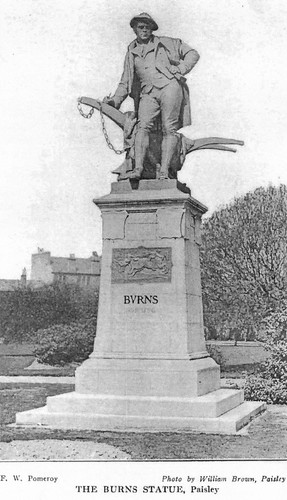
It is the work of a London sculptor, Mr. F. W. Pomeroy, whose design was chosen on the recommendation of Sir Thomas Brock, the Royal Academician, sculptor of the National Memorial to Queen Victoria in London, and knighted by King George on the occasion of its dedication, May, 1911. The poet is represented clad in the costume of the period tail coat, knee breeches and broad Kilmarnock bonnet leaning on an old Scottish plough. In his right hand, which rests on the plough, is a pencil, and in his left a note book. The attitude is contemplative. The statue proper is of bronze, ten feet high, and with the pedestal twenty-two feet. The pedestal is of gray granite, and has one panel of aluminum in front, representing "Tam o' Shanter" crossing the Brig o' Doon chased by the witches.

Elsewhere, we learn that Frederick Pomeroy, who had already contributed some sculpted panels to a building in Paisley, won a competition with his design of the Burns sculpture. This is the Paisley version:

Original

Apart from the chain attached to the plough, which does not appear in the Sydney version, I have not yet found the minor details in which the sculptor agreeably adopted some suggested alterations made by the Sydney committee; although the pedestal, (the design of Mr. J. W. Manson of Sydney, who acted as honorary architect, is of granite and is somewhat different from the commonplace style so widely adopted for similar statues, and surely harmonizes with the strong, rough, natural genius of the poet ) lacks the Tam o' Shanter aluminium panel attached to the Paisley statue.

Edward Pinnington, a contemporary art critic said of the Paisley statue:

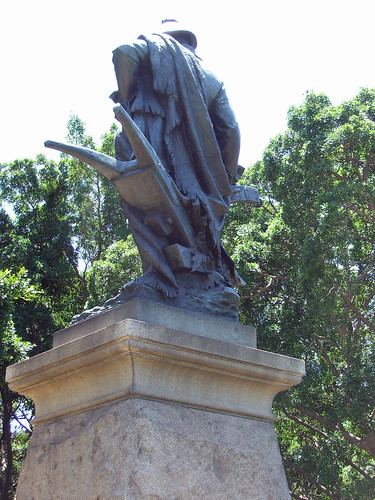
"F. W. Pomeroy wisely abandoned precedent and convention without roughly defying prevailing views of physical likeness. Burns looks every inch a man; somewhat ponderous, perhaps, across the loins for agility, but muscular, broad and strong. An ample plaid lends the burly peasant all the grace he needs, and, falling over the plough at the back, partly hides a thistle. The emblem is not obtruded, because the sculptor wishes the poet to be seen as the Poet of Humanity first, and as that of Scotland afterwards. Mr. Pomeroy tried for something original and he succeeded. In his Burns he has portrayed the thinker and poet of boundless potentiality, without neglecting the toil-bent worker or the athlete. Capable as a work of art, the statue is endowed with a life-like vigor and picturesque grace which ensure its acceptance."

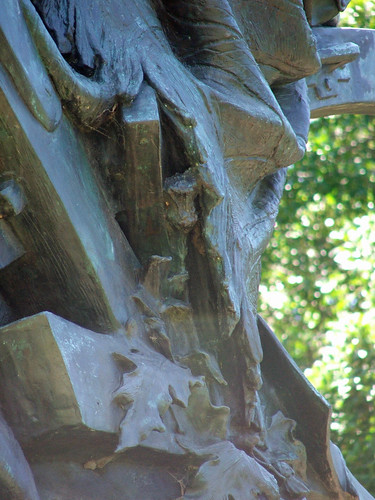
I hadn't thought to look at the back of the Domain statue before reading this, but if you doubted plaid could be represented in bronze - there it is:

Plaid

And the thistle too :

Thistle

New Zealand has one  as well - in 1921, a replica of the Paisley statue was unveiled in Auckland.

Sunday, 8 November 2009

THE CASTLE

dbc

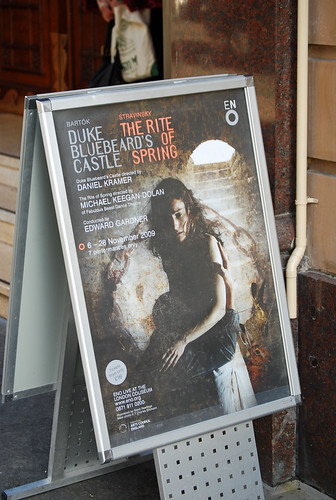
Bluebeard’s Castle is a one-act opera by Bela Bartok to a libretto by Béla Balázs . It is a version of an old story which has appeared in many forms. Judith abandons her family and fiancé and accompanies Bluebeard to his castle, although she is aware of many rumours about Bluebeard, his castle, and the fate of his former wives. The hall of the castle is dark and has seven locked doors. With varying degrees of reluctance, Bluebeard agrees to Judith’s requests to open the doors and let in the light. Behind the doors are found: Bluebeard’s torture chamber; his armory; his treasure house; his garden; his vast kingdom; a pool of tears; and behind the seventh door his three wives. Although, much blood has been found behind the doors, the wives, notwithstanding rumour, are alive and at the conclusion, Judith is obliged to join them as the fourth wife. There is a review of the work in Wikipedia.

The story can be read as a creepy gothic romance, or a metaphor for Judith’s desire to open the doors to Bluebeard’s mind; it can be interpreted in Freudian terms (if you like that kind of thing) and so on.

I first saw Bluebeard’s Castle at the Washington National Opera in 2006, in a production by the film director, William Friedkin (who made The Exorcist ) which was first seen in Los Angeles. Samuel Ramey was Bluebeard and Denyce Graves, Judith. It was an elegant, abstract production in which Bluebeard and Judith approached the castle in a gondola with birds swooping over their heads. The seven doors were seen to open at the rear of the stage letting in light of various colours. The production was very effective and allowed the imagination to roam over the possible readings or meanings of the work. I was left with the feeling that it was an opera which emaphasised the wonderful orchestral score over the singers, and this may have been influenced by the production itself to some extent. The orchestral score is a great piece in itself – (there are echoes of it in Bartok’s later Concerto for Orchestra).

I have mentioned this production because, while I enjoyed the new production of Bluebeard by the English National Opera at the London Coliseum, I was very glad that it was not my introduction to the work.

The new production was directed by Daniel Kramer with ENO musical director Edward Gardner conducting. Clive Bayley is Bluebeard and Michaela Martens, Judith.

The ENO production confines the story to particular reading, some parts of which were obscure to me. The castle is reduced to a room, which appears at times to be below street level. Bluebeard is depicted as a psychotic with a tendency to revert to childhood fantasy; for example, his armoury contains a castle made of toy blocks and a ride-on canon on wheels. He sometimes moves in an odd jerky way, which I suppose is intended to represent his appalling mental condition. Clive Bayley has a fine voice and sung the role very well. He may have been even better if allowed to sing unimpeded by some of the strange bodily contortions the characterisation required.

The greatest departure from a traditional account of the work was that Bluebeard’s kingdom revealed at the opening of the fifth door was not a vast estate, but children who emerged from bunk beds at the back of the stage, stood from time to time in order of height, and were united with their mothers when the wives emerged from behind the final door. While this did some violence to the original conception, it is an interesting approach as it seems possible, even likely, that Bluebeard’s household included children. Like the location of the “castle” in a cellar, the children may also be a reference to recent cases of the abduction or imprisonment of women, which are mentioned in a program note.

There is a violent conclusion in which it appears the wives including Judith are subjected to genital mutilation by a sword wielding Bluebeard. Apart from theatrical shock value, I did not understand this and am unable to see how it fits with the overall concept of the production. Both the music and the impetus of the story seem to lie better with the realisation that Judith’s fate is to join the other wives in their joyless imprisonment.

Michaela Martens Judith was well acted and marvelously sung. Her character seemed to develop with the story as the intensity of her demands for the doors to open increased with the bloodstains which eventually covered her dress.

The orchestra too was excellent. There was a specially exciting moment at the opening of the fifth door when it was augmented by an additional brass section in a upper box and the luminous sound of Bartok’s music for Bluebeard’s kingdom filled the theatre.

Unlike some “director’s opera” this production does not impose anything foreign to the work itself. It is one of many possible readings of the story, but a very limited one. By approaching the work in this way, the director closes out other readings and to some extent at least extinguishes the ambiguities which make it such a fascinating opera.

In Washington, Bluebeard’s Castle was followed by Puccini’s Gianni Schicchi. This combination is faulted by Edward Gardner in an ENO program note, but I thought it worked very well. The change of tone is welcome, and it gives the baritone the opportunity to sing two entirely different roles on the one night. The Washington production carried some scenic elements (stylised birds for example) from Bluebeard to Schicchi with amusing effect.

At ENO it was a night of serious modernism: Stravinsky’s Rite of Spring was performed by Fabulous Beast Dance Theatre as the second half of the program. I know nothing about ballet or dance, I can only say I enjoyed it.


Duke Bluebeard's Castle and The Rite of Spring.  English National Opera at the London Coliseum,
 6 November 2009

Sunday, 1 November 2009

Amazing

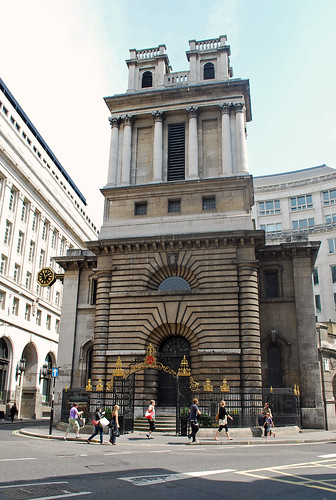
Church
I became interested in Nicolas Hawksmoor and his London churches in April this year when I saw the Lion and Unicorn gamboling around the tower of St. George’s Bloomsbury and looked into their history. I visited each of the six churches in May; but I only saw St. Mary Woolnoth from the outside as it was closed on the Bank Holiday of my visit. I had only known of the church from its appearance in T.S. Eliot’s The Waste Land:


Sighs, short and infrequent, were exhaled,
And each man fixed his eyes before his feet.
Flowed up the hill and down King William Street,
To where Saint Mary Woolnoth kept the hours
With a dead sound on the final stroke of nine.


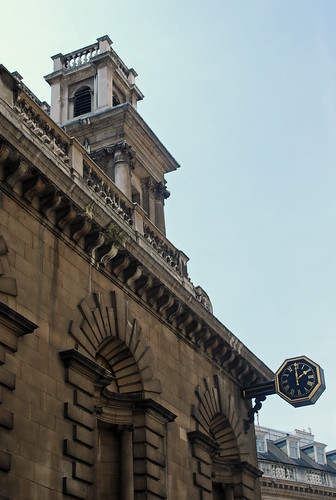
And I wanted to hear if it indeed kept the hours. It was approaching 2 p.m. and I waited near the clock for the hour, but no sound was heard. I wondered if Eliot’s line was an obscure joke of some kind, or if the clock struck, but only some of the time.

Clock

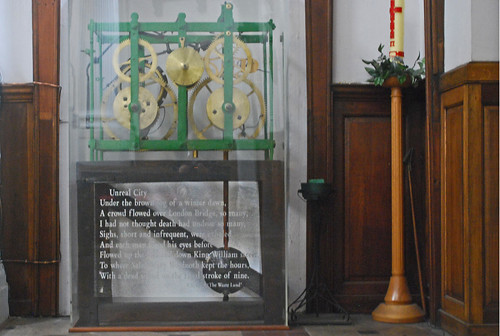
I returned to the church in late October and found it open. The clock was set at 12, indicating that it was not in working order. But inside the church I was surprised to find a clock mechanism and pendulum in a glass case inscribed with the passage from The Waste Land. Perhaps this was the clock that kept the hours but I couldn’t find anything about its history.

Clock


A young man was arranging a display of Christmas Cards for sale in the porch and I asked him what he knew.

“Sorry, I only started here yesterday.”

And “The Reverend’s away until Monday”.

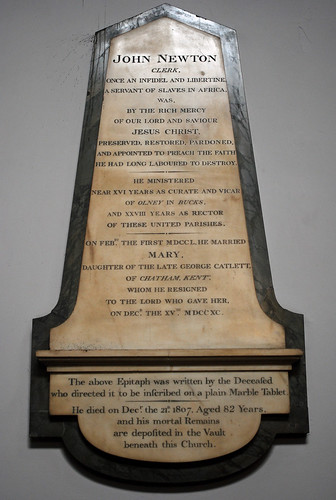
The Waste Land is not the only verse associated with the church. There is a memorial on the wall for John Newton, author of the words to Amazing Grace.

John Newton


Amazing Grace, how sweet the sound,
That saved a wretch like me.
I once was lost but now am found,
Was blind, but now I see.


According to the Wikipedia article on this hymn, it only began to be sung to the tune associated with its modern popularity in the twentieth century, the tune first appearing in 1829; and if this is correct Newton was blessed by never having to endure it himself.

It’s an unusual combination of associations: an eighteenth century evangelical hymn and probably the best known modernist poem in English.


When I find out more about the final stroke of nine I will add it here.